Imagine a massive software launch. The development team is furiously writing code, the marketing department is prepping a multi-channel ad campaign, and the sales team is briefing enterprise clients on new features. Suddenly, a critical third-party API fails, marketing promises a feature that was quietly cut from the scope, and nobody knows who has the authority to push the launch date back. Chaos ensues.
This is exactly the moment a project manager (PM) proves their worth.
If you have ever wondered what does a project manager do when the pressure is on, the answer is simple: they are the person who turns abstract ideas into executed reality. A PM keeps the project’s scope, timeline, budget, and human beings perfectly aligned. They do not necessarily write the code, pour the concrete, or design the graphics, but they ensure that the people doing those jobs have exactly what they need to succeed.
In this modern career guide, we will break down the project manager roles and responsibilities, explore the day-to-day realities of the job, and look at the core project manager skills required to thrive in 2025 and beyond. Whether you are a career switcher, a hiring manager, or a team member looking to understand your PM better, this guide covers exactly how this critical role creates value across industries.
What Is a Project Manager?
At the most basic level, a project manager is a professional responsible for planning, executing, and closing projects within specific constraints—usually time, budget, and scope. Every project moves through standard project lifecycle phases: initiation, planning, execution, monitoring/controlling, and closing. The PM is the owner of this lifecycle.
Think of the PM as the “central hub” of a wheel. The spokes connect to executive leadership (who care about ROI and strategy), external stakeholders (who care about deliverables and quality), and the internal delivery team (who care about clear requirements and bandwidth). Effective stakeholder management in project management means the PM translates executive vision into actionable daily tasks for the team, while simultaneously translating technical roadblocks into business impacts for the executives.
You do not always need a traditional background to enter this field. Many successful PMs transition into the role from engineering, marketing, operations, or IT. While formal credentials like the PMP certification responsibilities (Project Management Professional), CAPM, PRINCE2, or Agile/Scrum certifications are highly valued in the US job market, real-world experience in coordinating complex work is often just as critical. A standard project manager job description focuses less on your ability to do the technical work and more on your ability to organize the people who do.
Core Responsibilities of a Project Manager
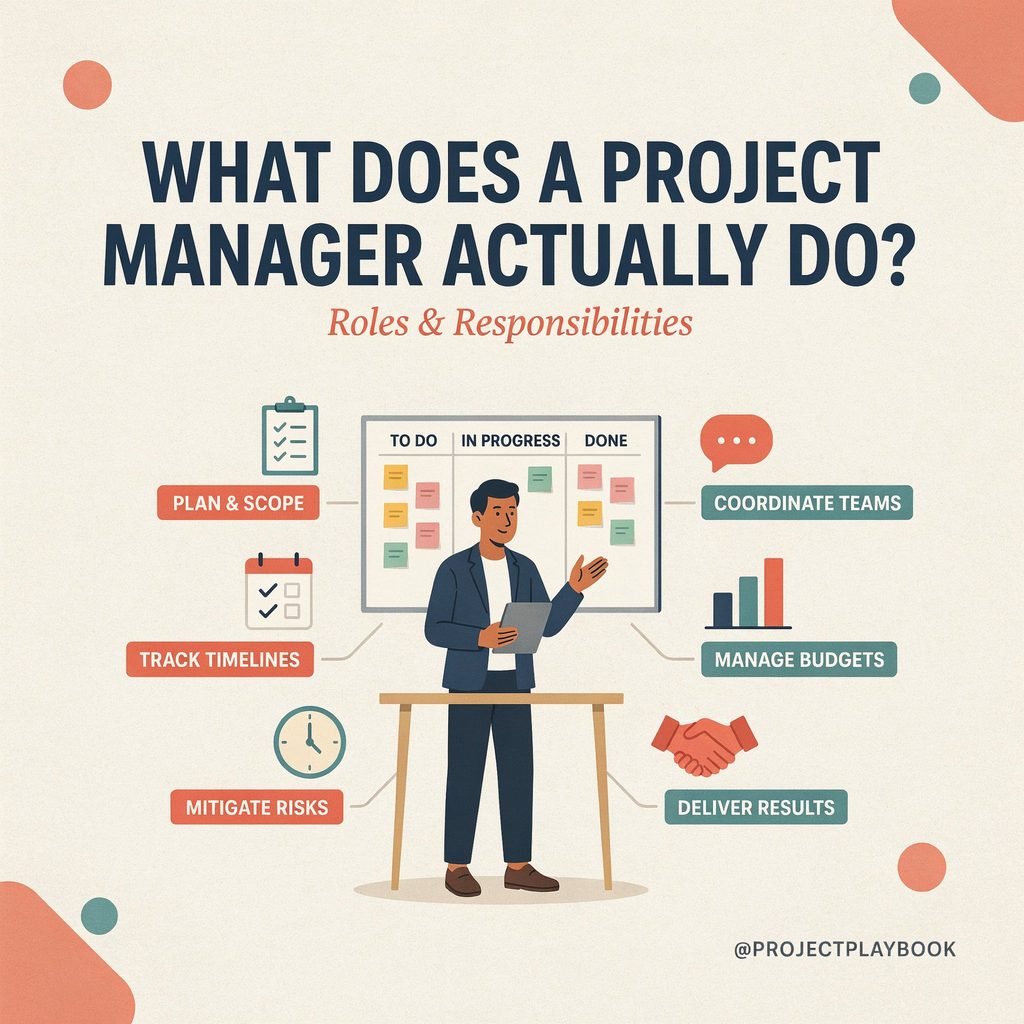
The project management responsibilities of a modern PM are vast, blending analytical planning with intense human coordination. Here is a detailed look at the primary project manager duties.
Defining Scope, Goals, and Success Criteria
Before any work begins, the PM must define the boundaries of the project. This is known as project scope management. The PM works with stakeholders to set clear objectives, define the final deliverables, and explicitly document what is out of scope to prevent “scope creep” (the gradual, unauthorized expansion of project goals).
To make this actionable, PMs often create a work breakdown structure (WBS). A WBS is a method of breaking down large, intimidating deliverables into smaller, manageable, and assignable chunks. If the goal is to “build a website,” the WBS breaks it down into wireframing, copywriting, backend development, and QA testing.
Planning Schedules, Milestones, and Resources
Project planning and scheduling is the backbone of the role. PMs build realistic timelines, sequence dependent tasks (e.g., you cannot test the software before it is coded), and set milestones to track progress. Beyond time, they must allocate resources. This means ensuring the right people are assigned to the right tasks, securing the necessary software or equipment, and managing the project budget.
Leading and Coordinating the Team
A PM is a leader without necessarily having direct HR authority over the team. They run project kickoffs to align everyone on the vision, facilitate daily or weekly stand-up meetings, and lead retrospectives to discuss what went well and what did not. Most importantly, they assign tasks and actively unblock the team. If a designer is waiting on copy from a marketing lead, the PM steps in to resolve the bottleneck.
Managing Budget, Costs, and Vendors
Budget management project manager tasks involve tracking every dollar spent against the approved financial baseline. The PM monitors burn rates, flags financial variances early, and forecasts final costs. When external contractors or agencies are involved, the PM coordinates these vendors, reviews invoices, and negotiates or approves change orders when the scope shifts.
Risk Management and Problem Solving
Risk management for project managers is about being proactive rather than reactive. PMs maintain a “risk register”—a living document that identifies potential pitfalls (e.g., a key developer might leave, or a vendor might miss a shipping deadline) and outlines contingency plans. When unexpected issues arise, the PM acts as the first responder, gathering facts and presenting solutions to leadership rather than just reporting the problem.
Communication and Stakeholder Management
A PM spends up to 90% of their time communicating. They serve as the bridge between technical teams and non-technical clients. This involves creating status dashboards, sending weekly progress reports, and establishing clear escalation paths. Good communication ensures that stakeholders are never surprised by bad news at the last minute.
Quality Control and Delivery
It does not matter if a project is on time and under budget if the final product is broken. PMs ensure deliverables meet agreed-upon success criteria before handoff. Depending on the industry, this means coordinating user acceptance testing (UAT), scheduling safety inspections, or managing peer-review cycles.
Closing Projects and Capturing Lessons Learned
A project is not done until the paperwork is finished. Formal closeout includes securing final client sign-offs, archiving documentation, releasing resources, and handing the product over to operations or maintenance teams. Crucially, the PM runs a retrospective to capture “lessons learned,” ensuring the organization does not repeat the same mistakes on the next project.
A Day in the Life of a Project Manager
To truly understand the day in the life of a project manager, you have to look past the stereotype of someone simply updating spreadsheets. The reality is a fast-paced mix of strategic foresight and tactical firefighting. While remote project manager work has shifted some of these interactions to Zoom and Slack, the core rhythm remains the same.
Here is a realistic timeline of a typical day for a mid-level PM in a tech or corporate environment:
- 8:30 AM – 9:30 AM: Dashboard Triage & Prioritization
The day starts with a review of the project management software dashboards. The PM checks for overnight updates from remote or offshore teams, scans emails for urgent blockers, and reviews the day’s calendar. They identify the top three critical path items that must move forward today and adjust priorities based on any new roadblocks. - 9:30 AM – 11:00 AM: Syncs, Stand-ups, and Unblocking
The mid-morning is heavy on synchronous communication. The PM leads a 15-minute daily stand-up with the delivery team. The focus is strictly on progress and blockers. If a developer mentions they are stuck waiting for security clearance on a new server, the PM immediately takes that action item and spends the next hour pinging the IT security director to get it resolved. - 11:00 AM – 12:30 PM: Deep Work & Strategy
With the team unblocked, the PM shifts to deep work. This might involve refining the WBS for an upcoming project phase, updating the financial forecast, or drafting a risk mitigation plan for a newly identified supply chain delay. - 1:30 PM – 3:00 PM: Stakeholder & Vendor Syncs
The afternoon often features external-facing meetings. The PM might jump on a call with a third-party vendor to review a change order, or present a monthly status report to the executive steering committee. Here, the PM translates technical delays into business impacts, managing expectations and negotiating deadline shifts. - 3:00 PM – 4:30 PM: Documentation & Forward Planning
As the day winds down, the PM updates the central source of truth (like Confluence or a project wiki). They ensure meeting notes are published, decisions are logged, and the schedule for the following week is properly resourced. - 4:30 PM – 5:00 PM: The Wrap-Up
A final scan of communications to ensure no fires are burning, followed by a quick checklist review to prepare for tomorrow’s kickoff meetings.
This timeline highlights that a PM’s day is defined by coordination, decision-making, and control. Entry-level project manager tasks might lean heavily on updating schedules and taking meeting notes, but as you grow, the focus shifts to negotiation, risk strategy, and leadership.
Key Skills Every Project Manager Needs
Success in this field requires a blend of hard methodologies and soft interpersonal skills. If you are reviewing a project manager job description, you will see these core project manager skills repeatedly:
- Planning & Organization: The ability to look at a massive, ambiguous goal and reverse-engineer it into a step-by-step work breakdown structure (WBS). This requires intense attention to detail and mastery of project planning and scheduling techniques.
- Communication & Stakeholder Management: PMs must tailor their message to their audience. They need to speak the technical language of engineers while translating those concepts into ROI and timeline impacts for the C-suite. Expectation setting and conflict resolution are daily requirements.
- Leadership & Team Coordination: Because PMs rarely have direct firing or hiring power over their teams, they must lead through influence, empathy, and motivation. They facilitate collaboration and foster psychological safety so teams feel comfortable raising risks early.
- Analytical & Problem-Solving: PMs are professional trade-off negotiators. When a project falls behind, they must analyze data to decide whether to crash the schedule (add budget/resources), fast-track tasks (do things in parallel, increasing risk), or cut scope.
- Tool Fluency: Modern PMs must be highly proficient in project manager tools (Jira, Asana, MS Project), alongside collaboration platforms like Slack, Microsoft Teams, and advanced spreadsheet modeling for budget tracking.
- Adaptability & Resilience: Projects rarely go exactly to plan. Requirements change, budgets are slashed, and key team members quit. The ability to remain calm under pressure, pivot strategies without panicking, and guide a team through ambiguity is what separates average PMs from great ones.
Project Manager Roles Across Industries
While the core mechanics of the role remain the same, the daily realities shift dramatically depending on the sector. Titles vary, but the project management responsibilities adapt to the unique constraints of the industry.
IT & Software Development
In tech, the focus is heavily on Agile methodologies. IT project manager responsibilities often overlap with product management, but the PM is usually laser-focused on execution. They manage sprint planning, backlog grooming, and release coordination. The debate of Scrum master vs project manager frequently arises here: a Scrum Master strictly coaches the team on Agile processes and removes impediments, while the PM owns the broader timeline, budget, and cross-departmental coordination. Agile project manager responsibilities require comfort with iterative development, where the final product evolves based on continuous user feedback.
Construction & Engineering
Construction project manager tasks are highly tangible and bound by physical realities and strict regulatory codes. These PMs spend significant time on-site coordinating subcontractors (electricians, plumbers, framers), managing safety inspections, reviewing architectural submittals, and dealing with weather delays. Change orders in construction are highly formalized legal documents, and budget overruns can cost millions in physical materials.
Marketing & Creative
Marketing PMs operate in a fast-paced, highly subjective environment. They manage campaign timelines, digital asset production, and agency coordination. Their biggest challenges are usually creative bottlenecks, endless revision loops, and aligning brand messaging across multiple channels before a strict launch date.
Product & Operations
In corporate operations, PMs drive internal cross-functional initiatives. This could be migrating a company to a new HR software system, opening a new regional office, or executing OKR-aligned process improvements. These PMs excel at change management, convincing employees to adopt new ways of working.
Despite the industry, senior project manager duties universally involve managing a portfolio of interconnected projects or highly complex, multi-million-dollar initiatives that span multiple global offices.
Common Misconceptions About Project Managers
Because the role is so pervasive, it is often misunderstood. Let’s clear up a few persistent myths:
Myth 1: “PMs just send status emails and update Gantt charts.”
While documentation is part of the job, a PM’s true value is in what happens between the meetings. They are negotiators, risk mitigators, and unblockers. If a PM is only updating charts, the project is likely already failing.
Myth 2: “PMs don’t need domain knowledge.”
While you do not need to be a master coder to manage a software project, or a licensed architect to manage a build, you do need enough domain fluency to ask the right questions. A PM must understand the technical jargon well enough to know when a developer is underestimating a task or when a vendor is overcharging.
Myth 3: “Any organized person can be a PM without training.”
Being personally organized is a great start, but managing a $5M budget, navigating corporate politics, and applying formal risk management for project managers requires specialized training and methodologies. Structure and leadership must be intentionally developed.
Is Project Management the Right Career for You?
Project management is an incredibly rewarding career, but it is not for everyone. It is an ideal fit if you derive genuine satisfaction from bringing order to chaos. You should consider this path if you enjoy cross-functional work, possess high emotional intelligence, and are comfortable making decisions with incomplete information. If you prefer to put on noise-canceling headphones and focus on a single, isolated task for eight hours a day, project management will likely lead to burnout.
The career trajectory is also highly attractive. A common path begins with entry-level project manager tasks as a Project Coordinator or Junior PM. From there, professionals advance to Project Manager, then Senior PM. Experienced leaders often move into Program Management (overseeing a group of related projects) or Portfolio Management (aligning all projects with company strategy). Ultimately, the broad business acumen gained in this role makes PMs prime candidates for Director of Operations or Chief Operating Officer (COO) positions.
Conclusion
So, what does a project manager actually do? They are the glue that keeps complex, moving parts from flying apart. They balance the iron triangle of scope, time, and cost while leading human beings through the stress of delivery. Whether they are managing a skyscraper build or a software sprint, their core mission remains the same: delivering value efficiently and predictably.
Looking toward the future, the role is rapidly evolving. AI in project management is automating routine administrative tasks like schedule generation and predictive risk modeling, freeing up PMs to focus entirely on high-level strategy, relationship building, and complex problem-solving. As remote work and globalized teams become the permanent standard, the ability to align diverse groups of people toward a single, unified goal has never been more valuable.