
Have you ever wondered what is Scrum and why it dominates the world of modern project management? If you are transitioning from traditional workflows or just stepping into Agile project management, Scrum might seem like a maze of unfamiliar jargon. In simple terms, Scrum is a lightweight framework that helps teams solve complex problems and deliver high-value products iteratively. Instead of spending months building in isolation only to miss the mark, Scrum breaks work into manageable cycles called Sprints.
Why does this matter for Agile teams? Because it replaces rigid plans with empirical process control, allowing teams to adapt to change quickly. This beginner’s blueprint covers everything you need to know. We will explore the official Scrum terminology, including the three accountabilities, five events, and three artifacts. You will learn how a self-managing, cross-functional team uses transparency, inspection, and adaptation to drive continuous improvement. Whether you are in software development, marketing, or product design, understanding Scrum methodology is your first step toward delivering real value. Let’s dive into the mechanics of the Scrum framework!
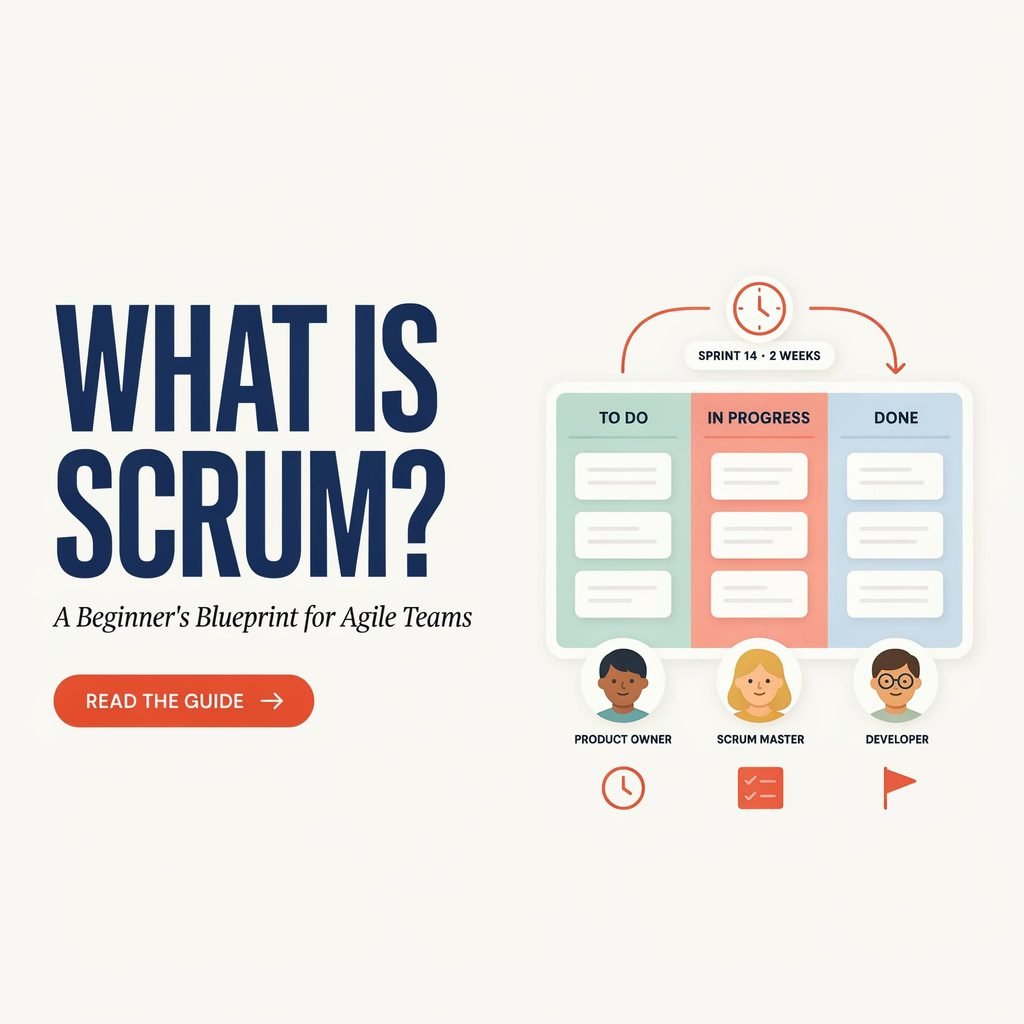
What Is Scrum?
Scrum is a specific framework within the broader Agile methodology designed to help teams deliver value incrementally. It provides a structured yet flexible approach to Scrum project management, focusing on short, repeatable work cycles. Rather than a rigid set of rules, it offers a scaffold for teams to collaborate, learn, and adjust.
Scrum vs Agile: Understanding the Difference
People often confuse Agile and Scrum. While they are closely related, they are not the same thing. Agile is a broad mindset and philosophy defined by the Agile manifesto, emphasizing flexibility, customer collaboration, and responding to change. Scrum, on the other hand, is a specific Scrum framework used to implement Agile principles in practice. Think of Agile as the overarching dietary philosophy of eating healthy, while Scrum is a specific meal plan like the Mediterranean diet.
| Feature | Agile | Scrum |
|---|---|---|
| Nature | Broad mindset and set of values | Specific framework for execution |
| Scope | Encompasses many methodologies | One specific Agile methodology |
| Focus | Customer satisfaction & adaptability | Iterative delivery via Sprints |
| Structure | Flexible, no strict rules | Defined roles, events, and artifacts |
Why Teams Use Scrum
Teams choose Scrum because it drastically reduces risk and accelerates time-to-market. By embracing iterative development, teams deliver working pieces of a product early and often. This approach fosters incremental delivery, meaning stakeholders see tangible progress quickly. Furthermore, Scrum promotes a self-managing team environment, boosting morale and productivity. When teams have the autonomy to figure out how to accomplish their work, they innovate faster and solve problems more creatively.
The Core Values of Scrum
The Scrum framework relies on five core values: Commitment, Courage, Focus, Openness, and Respect. Teams commit to achieving their goals and have the courage to tackle tough problems. They focus on the work of the Sprint and remain open about challenges. Finally, they respect each other as capable, independent professionals. These values are the bedrock of empirical process control, ensuring that transparency, inspection, and adaptation can thrive.
How Scrum Works: The Basic Workflow
The basic workflow revolves around the Sprint. A team selects work from a prioritized list, executes it over a short timeframe, reviews the output, and reflects on their process. This loop repeats continuously, driving continuous improvement sprint by sprint.
| Scrum Component | Type | Description |
|---|---|---|
| Product Owner | Accountability | Maximizes product value and manages the backlog. |
| Scrum Master | Accountability | Coaches the team and removes impediments. |
| Developers | Accountability | Cross-functional team that builds the Increment. |
| Product Backlog | Artifact | Ordered list of all needed work. |
| Sprint Backlog | Artifact | Selected work for the current Sprint. |
| Increment | Artifact | Usable, completed work at the end of a Sprint. |
Scrum Team Roles and Accountabilities
The Scrum team consists of three specific accountabilities. Note that the 2020 Scrum Guide uses “accountabilities” rather than just “roles” to emphasize ownership and results over job titles. Scrum moves away from traditional hierarchies. Instead of a manager assigning tasks, the Developers pull work from the backlog. The Scrum Master is not a boss, but a coach. The Product Owner is not a project manager dictating deadlines, but a visionary guiding value.
Product Owner
The Product Owner is accountable for maximizing the value of the product. They manage the Product Backlog, ensuring it is transparent, visible, and prioritized. They represent the stakeholders and define the “what” and “why” of the work.
Scrum Master
The Scrum Master is accountable for establishing Scrum as defined in the Scrum Guide. They coach the team, remove impediments, and facilitate Scrum ceremonies. They serve the team, the Product Owner, and the organization by championing Agile principles.
Developers
The Developers are the professionals who do the actual work. They are a cross-functional team, meaning they possess all the skills necessary to create value. They are accountable for creating the Sprint Backlog, ensuring quality through the Definition of Done, and adapting their plan daily.
Scrum Artifacts Explained
Artifacts represent work or value and ensure transparency. Transparency is critical here. If the Product Backlog is outdated, the team builds the wrong things. The Product Owner is accountable for the Product Backlog, ensuring stakeholders understand the roadmap. The Developers own the Sprint Backlog, updating it daily to reflect reality. The Increment must be usable; it cannot be half-baked code that sits on a local machine. It must be integrated and tested.
Product Backlog
An emergent, ordered list of what is needed to improve the product. It is the single source of work for the Developers.
Sprint Backlog
The set of Product Backlog items selected for the Sprint, plus a plan for delivering them. It is managed by the Developers.
Increment
A concrete stepping stone toward the Product Goal. Multiple Increments can be created within a Sprint, and they must work together to provide value.
Scrum Events Explained
Scrum events (or Scrum ceremonies) create regularity and minimize the need for meetings not defined in Scrum. All Scrum events are timeboxed, meaning they have a maximum duration. This ensures focus and prevents endless meetings. Sprint Planning is usually timeboxed to eight hours for a one-month Sprint. The Daily Scrum is strictly 15 minutes. The Sprint Review takes up to four hours, and the Sprint Retrospective takes up to three hours. Timeboxing forces the team to prepare in advance and stay on topic, which is a cornerstone of Scrum best practices.
Sprint
The heartbeat of Scrum. A Sprint is a fixed length event of one month or less where the work happens. A new Sprint starts immediately after the conclusion of the previous one.
Sprint Planning
This initiates the Sprint. The entire Scrum Team collaborates to define the Sprint Goal and select items from the Product Backlog. They answer three questions: Why is this Sprint valuable? What can be Done? How will the work get done?
Daily Scrum
A 15-minute daily event for the Developers. They inspect progress toward the Sprint Goal and adapt the Sprint Backlog as necessary. It is not a status report to management, but a synchronization tool for the team.
Sprint Review
Held at the end of the Sprint, the Scrum Team presents the Increment to stakeholders. They discuss what was accomplished, what changed in the environment, and adapt the Product Backlog as needed.
Sprint Retrospective
The final event of the Sprint. The Scrum Team inspects how the last Sprint went regarding individuals, interactions, processes, and tools. They create a plan for improvements to be enacted during the next Sprint.
Scrum Commitments: Product Goal, Sprint Goal, and Definition of Done
In 2020, commitments were introduced to reinforce the artifacts and provide clarity.
- Product Goal: The long-term objective for the Scrum Team. It resides within the Product Backlog.
- Sprint Goal: The single objective for the Sprint. It is created during Sprint Planning and resides in the Sprint Backlog, giving the team flexibility regarding the exact work required.
- Definition of Done: A formal description of the state of the Increment when it meets the quality measures required for the product. It ensures everyone shares a common understanding of what work was completed.
A Simple Example of Scrum in Action
Imagine a Scrum in software development scenario: a team building a mobile banking app. The Product Owner prioritizes a feature for “Mobile Check Deposits.” During Sprint Planning, the Developers commit to a Sprint Goal: “Allow users to successfully upload a check image.”
Over a two-week Sprint, the Developers build the camera integration and backend processing. In the Daily Scrum, they sync up; a Developer might say, “I finished the camera UI but am blocked by the API.” The Scrum Master steps in to resolve the API access issue.
At the Sprint Review, the team demonstrates the feature to stakeholders using a test phone. The stakeholders love it but ask for an automatic flash feature. The Product Owner adds this to the Product Backlog. In the Retrospective, the team realizes their code reviews took too long and agrees to pair-program more often to speed up the process.
Scrum in Marketing Example: Consider a marketing team launching a new product campaign. The Product Owner might be the Marketing Director, who prioritizes tasks like “Design social media assets,” “Draft email newsletters,” and “Coordinate influencer outreach.” The Developers are the copywriters, designers, and strategists. During the Sprint Review, they don’t demo code; they present the drafted copy and visual mockups to the executive team for feedback. In the Retrospective, they might realize that waiting for legal approval takes too long and decide to involve a legal rep earlier in the Sprint.
How to Implement Scrum: Step-by-Step Beginner Blueprint
- Form a Scrum Team: Identify your Product Owner, Scrum Master, and Developers. Ensure a cross-functional, self-managing team.
- Create a Product Backlog: Gather initial requirements and user stories. The Product Owner orders them by value, avoiding too much upfront detail.
- Define a Product Goal: Establish a clear, long-term objective that gives the team direction. When defining a Product Goal, make it inspiring and measurable. Instead of “update the website,” try “increase user engagement by 20% through a redesigned checkout flow.”
- Run Sprint Planning: Select the highest priority items that fit into your chosen timeframe. Define a clear goal.
- Choose a Sprint Length: Start with two weeks. It provides enough time to deliver value but is short enough to pivot quickly.
- Hold a Daily Scrum: Meet for 15 minutes every morning at the same time. Focus strictly on progress toward the Sprint Goal.
- Deliver an Increment: Ensure all completed work meets the Definition of Done and is potentially releasable.
- Conduct Sprint Review: Demo the working product to stakeholders. Gather feedback to refine the backlog.
- Conduct Sprint Retrospective: Discuss what went well and what didn’t. Pick one actionable improvement for the next Sprint.
- Improve Iteratively: Repeat the cycle, applying your retrospective learnings to continuously refine your process.
Common Scrum Mistakes to Avoid
- Treating the Daily Scrum as a status meeting: It is for Developers to plan the next 24 hours, not to report to the Scrum Master.
- Skipping the Retrospective: Without this, teams stagnate and fail to achieve continuous improvement.
- Product Owner absence: The Product Owner must be available to answer questions and clarify requirements during the Sprint.
- Ignoring the Definition of Done: Calling work “done” when it lacks testing or documentation creates technical debt and ruins transparency.
- Overloading the Sprint: Taking on too much work leads to burnout and compromised quality.
- Zombie Scrum: This happens when a team goes through the motions but lacks the empirical mindset. They hold a Daily Scrum but nobody listens. True Agile project management requires genuine commitment, not just checking boxes.
Scrum Best Practices for Agile Teams
- Keep the team stable: Avoid swapping members in and out of the team frequently. Stable teams build trust and rhythm.
- Protect the Sprint: Once the Sprint starts, the scope should remain relatively stable. Avoid injecting new, unrelated urgent tasks.
- Visualize the workflow: Use physical or digital boards (like Jira or Trello) to make the Sprint Backlog highly visible.
- Empower the team: Let the Developers decide how to accomplish the work. Micromanagement kills the benefits of self-management.
Is Scrum Right for Your Team?
Scrum is ideal for complex work where requirements are expected to change. While it originated in software development, Scrum implementation works well in marketing, design, and research. If your team faces uncertainty and needs to collaborate closely, Scrum is an excellent fit. For simple, repetitive tasks with predictable outcomes, traditional methods are often better.
Frequently Asked Questions About Scrum
- What is Scrum in simple terms? It is a framework for teams to break large projects into small, manageable pieces delivered in short cycles, allowing for constant feedback and adjustment.
- Is Scrum the same as Agile? No. Agile is a broad mindset and philosophy outlined in the Agile manifesto, while Scrum is a specific framework used to implement Agile values in daily work.
- What are the 3 roles in Scrum? Technically, the 2020 Scrum Guide defines three accountabilities rather than roles to emphasize ownership: the Product Owner, the Scrum Master, and the Developers.
- What are the 5 Scrum events? The Sprint, Sprint Planning, Daily Scrum, Sprint Review, and Sprint Retrospective.
- What are the 3 Scrum artifacts? The Product Backlog, the Sprint Backlog, and the Increment.
- How long is a Sprint? Usually between one and four weeks, with two weeks being the most common industry standard.
- What does a Scrum Master do? They act as a servant-leader, coaching the team in Scrum theory, removing roadblocks, and facilitating events.
- What does a Product Owner do? They maximize product value by managing and prioritizing the Product Backlog based on stakeholder needs.
- Can Scrum be used outside software development? Yes, marketing teams, HR departments, and educational institutions use Scrum to manage complex, collaborative projects.
- What is the difference between a Scrum Master and a project manager? A project manager traditionally directs work and manages scope and timelines. A Scrum Master coaches the team to manage their own work and removes impediments, fostering self-management.
Conclusion: Getting Started With Scrum
Understanding what is Scrum is the first step toward transforming how your team delivers value. By embracing the Scrum framework, you empower your team to navigate complexity, adapt to change, and build better products through iterative development. Remember, mastering Scrum for beginners is a journey, not a destination. You don’t need to be perfect on day one. Start by forming a simple team, write a basic backlog, define a Sprint Goal, and just begin. Learn from your Sprint Review, adapt during your Retrospective, and improve incrementally. Your Agile journey starts with a single Sprint.