Every year, organizations lose billions of dollars to failed projects—missed deadlines, blown budgets, and deliverables that don’t meet expectations. The difference between projects that succeed and those that spiral out of control almost always comes down to one thing: how well the project manager understands and applies the project management knowledge areas.
The Project Management Institute (PMI) codified these principles in the PMBOK Guide (Project Management Body of Knowledge), the gold-standard reference for PMI project management worldwide. Whether you’re managing a software sprint, a commercial construction build, or a company-wide transformation initiative, the PMBOK knowledge areas give you a structured, repeatable framework for planning, executing, and controlling work.
If you’re a new project manager, a team lead stepping into a PM role, or a professional preparing for PMP exam preparation, understanding these ten domains isn’t optional—it’s foundational. They shape how you define scope, protect the triple constraint (scope, time, cost), manage risk identification and mitigation, and keep stakeholders aligned from kickoff to closeout.
In this guide, you’ll get a clear, practical breakdown of each of the 10 knowledge areas of project management, complete with real-world examples, common pitfalls, and actionable tips. By the end, you’ll have a working mental model you can apply to your very next project.
What Are Project Management Knowledge Areas?
In the PMBOK Guide, knowledge areas are categorized clusters of project management processes that address a specific discipline or subject within a project. Think of them as ten lenses through which you view and manage your project.
The PMBOK Guide (6th edition) identifies 49 project management processes distributed across these ten knowledge areas. Each process belongs to one knowledge area and one of five process groups:
- Initiating – Authorizing the project or phase
- Planning – Defining objectives, scope, and approach
- Executing – Completing the work defined in the plan
- Monitoring & Controlling – Tracking performance and managing changes
- Closing – Finalizing all activities and formally ending the project
The knowledge areas cut across these process groups. For example, Project Risk Management includes processes in planning (identify risks), executing (implement risk responses), and monitoring & controlling (monitor risks). This cross-cutting design reflects reality: you don’t stop managing risk just because you’ve moved from planning into execution.
PMI project management standards treat these areas as interdependent. A change in one almost always ripples into others, which is why integration management sits at the center of the framework. Understanding these domains gives you the vocabulary and structure to manage complexity without losing sight of the big picture.
Overview of the 10 Knowledge Areas
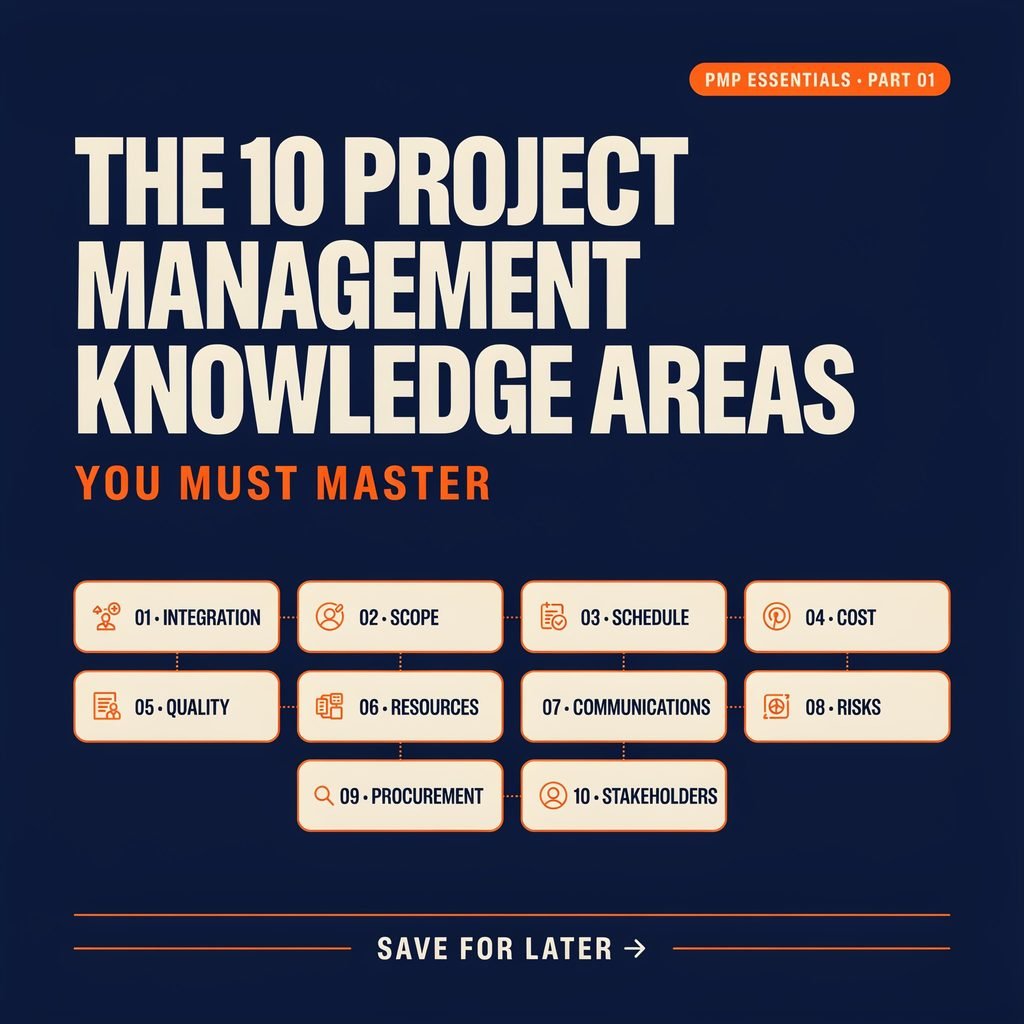
Here’s a quick-reference list of the 10 knowledge areas of project management:
- Project Integration Management – Unifying and coordinating all other areas
- Project Scope Management – Defining and controlling what is (and isn’t) included
- Project Schedule Management – Planning, sequencing, and tracking timelines
- Project Cost Management – Estimating, budgeting, and controlling expenses
- Project Quality Management – Ensuring deliverables meet requirements and standards
- Project Resource Management – Acquiring, developing, and managing people and assets
- Project Communications Management – Planning, distributing, and monitoring information
- Project Risk Management – Identifying, analyzing, and responding to uncertainties
- Project Procurement Management – Acquiring goods and services from outside the team
- Project Stakeholder Management – Engaging people who affect or are affected by the project
Each area deserves deeper exploration, which we’ll do next.
Deep Dive: The 10 Project Management Knowledge Areas
1. Project Integration Management
What it is: Integration management is the knowledge area responsible for unifying all project elements. It includes developing the project charter, creating the project management plan, directing and managing work, managing project knowledge, monitoring performance, performing the change control process, and closing the project.
Why it matters: Without integration, your project becomes a collection of disconnected tasks. Integration ensures every decision is made with the full picture in mind.
Key activities: Creating the project charter, developing the integrated project management plan, executing integrated change control, and conducting formal project closure.
Example: A product manager requests a new feature mid-sprint. Through integration management, you route the request through the change control process, assess impacts on schedule and budget, get sponsor approval, and update the plan—rather than simply saying yes and derailing the team.
Common pitfall: Skipping formal change control. Without a documented process, small requests accumulate into major scope drift.
2. Project Scope Management
What it is: Scope management defines exactly what the project will deliver—and, equally important, what it will not deliver. It covers requirements collection, scope definition, creating the Work Breakdown Structure (WBS), scope validation, and scope control.
Why it matters: Unclear scope is the number-one driver of scope creep, the gradual, uncontrolled expansion of project work that inflates timelines and budgets.
Key activities: Gathering stakeholder requirements, writing a detailed scope statement, decomposing work into a WBS, and obtaining formal acceptance of deliverables.
Example: A marketing agency building a client website documents 12 pages in the WBS. When the client later asks for three additional pages “while you’re at it,” the scope baseline makes it clear these are change requests requiring a revised timeline and budget.
Common pitfall: Failing to get written sign-off on scope. Verbal agreements dissolve under pressure. Always capture scope in a signed document.
3. Project Schedule Management
What it is: Schedule management (formerly “time management”) involves defining activities, sequencing them, estimating durations, developing the schedule, and controlling progress against it.
Why it matters: Time is one leg of the triple constraint. Delays cascade into cost overruns and stakeholder dissatisfaction.
Key activities: Activity definition, dependency mapping (finish-to-start, start-to-start, etc.), critical path analysis, milestone planning, and schedule performance tracking.
Example: A construction PM uses a Gantt chart to sequence foundation work, framing, electrical rough-in, and drywall. When a two-week delay hits the framing phase, the critical path analysis immediately shows the downstream impact on the electrical subcontractor’s start date.
Common pitfall: Building schedules without buffer or float. Always include contingency for known risks and unknown unknowns.
4. Project Cost Management
What it is: Cost management covers estimating, project budgeting, and controlling expenses so the project completes within the approved budget.
Why it matters: Financial overruns are the fastest way to lose executive support. Cost control protects the business case that justified the project in the first place.
Key activities: Bottom-up or analogous cost estimating, establishing a cost baseline with management reserves, tracking actual spend via Earned Value Management (EVM), and forecasting Estimate at Completion (EAC).
Example: An IT department budgets $400,000 for a cloud migration. By month three, EVM shows a Cost Performance Index (CPI) of 0.85, signaling the project is trending 15% over budget. The PM escalates early and renegotiates vendor licensing terms to recover.
Common pitfall: Underestimating indirect costs—training, change management, ongoing support. Build them into the budget from day one.
5. Project Quality Management
What it is: Quality management ensures the project’s deliverables satisfy stated and implied requirements. It includes quality planning, quality assurance (process-focused), and quality control (product-focused).
Why it matters: Delivering on time and on budget means nothing if the output doesn’t function as intended. Quality failures trigger rework, warranty claims, and reputational damage.
Key activities: Defining quality metrics, conducting audits and inspections, performing statistical sampling or testing, and implementing corrective actions.
Example: A pharmaceutical project defines acceptance criteria for a new packaging line: zero critical defects, less than 0.5% minor defects per batch. Quality control inspections at each stage catch a calibration drift before it produces 10,000 non-compliant units.
Common pitfall: Treating quality as an afterthought. Bake quality criteria into the scope statement and WBS, not just a final inspection checklist.
6. Project Resource Management
What it is: Resource management covers planning, acquiring, developing, and managing the people, equipment, and materials needed to complete project work.
Why it matters: Even a perfectly planned schedule fails if the right people aren’t available or if equipment arrives late.
Key activities: Resource planning, team acquisition, role-and-responsibility assignment (RACI matrix), team development, performance monitoring, and resource leveling.
Example: A consulting firm staffs a six-month transformation project. Midway through, two senior analysts are pulled onto another engagement. Because the PM maintained a resource calendar and flagged utilization limits, she secured backfill two weeks before the gap became critical.
Common pitfall: Ignoring soft skills—team conflict resolution, motivation, and workload balance. Technical skills alone don’t sustain a team through a long project.
7. Project Communications Management
What it is: Communications management ensures the right information reaches the right people at the right time in the right format. It includes planning, managing, and monitoring project communications.
Why it matters: PMI research consistently shows that poor communication is a leading cause of project failure. Stakeholders who feel uninformed become disengaged or adversarial.
Key activities: Stakeholder communication requirements analysis, selecting channels (status reports, dashboards, stand-ups), distributing information, and gathering feedback.
Example: A remote software team establishes a weekly 30-minute video stand-up for the core team, a bi-weekly email summary for the steering committee, and a real-time Slack channel for blockers. No one wonders what’s happening or where decisions stand.
Common pitfall: Over-communicating with the wrong detail level. Executives need summaries; engineers need specifics. Tailor the message to the audience.
8. Project Risk Management
What it is: Risk management is the systematic process of risk identification and mitigation, analysis (qualitative and quantitative), response planning, and ongoing monitoring.
Why it matters: Unmanaged risks become issues—and issues cost time, money, and morale. Proactive risk management converts surprises into managed events.
Key activities: Maintaining a risk register, scoring risks by probability and impact, assigning owners, developing mitigation or contingency plans, and reviewing risks at every status meeting.
Example: A logistics company planning a warehouse expansion identifies “permit approval delay” as a high-probability, high-impact risk. The mitigation plan includes submitting applications eight weeks early and retaining a backup contractor in case the first permit window slips.
Common pitfall: Creating a risk register at kickoff and never updating it. Risks evolve; review them weekly or at every sprint retrospective.
9. Project Procurement Management
What it is: Procurement management governs how the project acquires goods, services, or results from outside the performing organization. It covers procurement planning, solicitation, vendor selection, contract administration, and closure.
Why it matters: Most projects rely on external vendors. Poor procurement leads to cost overruns, quality gaps, and contractual disputes.
Key activities: Make-or-buy analysis, drafting Statements of Work (SOW), issuing RFPs/RFQs, evaluating proposals, negotiating contracts (fixed-price, T&M, cost-reimbursable), and managing vendor performance.
Example: An infrastructure project needs specialized drilling equipment. The PM issues an RFP with clear performance criteria, evaluates three bids, selects a fixed-price contract to transfer cost risk, and schedules monthly vendor performance reviews.
Common pitfall: Vague SOWs. If the vendor’s deliverables aren’t crystal clear in the contract, disputes are inevitable. Invest time upfront in precise specifications.
10. Project Stakeholder Management
What it is: Stakeholder management focuses on identifying everyone affected by the project, analyzing their interests and influence, planning stakeholder engagement, and managing relationships throughout the project lifecycle.
Why it matters: A technically perfect project can still fail if a key executive, regulator, or end-user opposes it. Stakeholder alignment is often the difference between adoption and abandonment.
Key activities: Stakeholder identification and register creation, power/interest grid analysis, engagement planning, expectation management, and monitoring stakeholder sentiment.
Example: A hospital IT team deploying a new electronic health records system maps 40+ stakeholder groups—physicians, nurses, billing staff, IT ops, patients. They discover that senior physicians, initially resistant, become champions once involved in the design review. Early engagement turned potential blockers into advocates.
Common pitfall: Engaging stakeholders only when you need something from them. Build relationships continuously, not transactionally.
How the Knowledge Areas Work Together
No knowledge area operates in isolation. The triple constraint—scope, time, and cost—illustrates the most obvious interdependency: expand scope, and you’ll need more time or money. Compress the schedule, and cost or quality may suffer.
But the web of dependencies goes deeper. Consider a mid-size software launch:
- A stakeholder requests two additional features (Stakeholder Management triggers a scope change).
- The change control board evaluates the request (Integration Management).
- The WBS is updated with new work packages (Scope Management).
- The schedule adds three weeks to accommodate development and testing (Schedule Management).
- The budget increases by $45,000 for additional developer hours (Cost Management).
- QA adds new test cases to maintain coverage (Quality Management).
- Two extra developers are pulled from another project (Resource Management).
- The team lead communicates the revised timeline to all stakeholders (Communications Management).
- The PM updates the risk register: tighter timeline raises the probability of integration bugs (Risk Management).
This single change ripples through eight of the ten areas. That’s why project planning and control must be holistic, and why Integration Management acts as the connective tissue—the “glue”—holding the project management framework together. The change control process is the mechanism that keeps these ripples coordinated rather than chaotic.
Applying the Knowledge Areas in Real Projects
Knowing the theory is one thing; using it on Monday morning is another. Here are practical ways to embed the PMBOK knowledge areas into your daily workflow:
- Use templates and checklists. Maintain a living project charter template, a risk register spreadsheet, a RACI matrix, and a change request form. Consistency reduces cognitive load.
- Leverage PM tools. Platforms like Microsoft Project, Smartsheet, Jira, or Monday.com can automate schedule tracking, resource allocation, and communication logs.
- Adapt to agile and hybrid environments. In Scrum, scope is managed through the product backlog, schedule through sprint cadence, and risk through retrospectives. The knowledge areas still apply; the rituals just look different.
- Tie knowledge areas to your PMP exam preparation. PMI’s exam tests your ability to apply these areas situationally. Study process inputs, tools, techniques, and outputs (ITTOs) in context, not in isolation.
- Review after each phase. At every stage gate or sprint boundary, ask: “Did I adequately address all ten areas this cycle?” This habit embodies project management best practices and prevents blind spots from compounding.
Whether you follow a predictive waterfall approach or an iterative agile model, the ten knowledge areas remain the conceptual backbone. They give you a shared language with sponsors, team members, and fellow practitioners.
Common Mistakes to Avoid
Even experienced PMs fall into predictable traps. Watch for these:
- Ignoring stakeholder engagement until it’s too late. If you only talk to stakeholders when you need a decision, you’ll face resistance. Engage early, engage often.
- Treating the risk register as a one-time exercise. Risks evolve. Schedule a standing risk review every week or sprint. Weak risk identification and mitigation invites costly surprises.
- Allowing scope creep to go undocumented. Every “small addition” that bypasses the change control process erodes your baseline. Say, “Yes, let’s process that through change control.”
- Overlooking resource conflicts. If two projects need the same specialist on the same dates and no one flags it, one project will slip. Maintain a shared resource calendar.
- Communicating one-size-fits-all. Sending a 20-page technical report to a CFO wastes everyone’s time. Match the message to the audience.
- Skipping lessons-learned sessions. Closing a project without capturing what worked and what didn’t guarantees you’ll repeat the same mistakes on the next one.
Addressing these mistakes head-on is one of the highest-leverage project management best practices you can adopt.
Conclusion
Mastering the project management knowledge areas isn’t about memorizing PMBOK terminology—it’s about building a reliable mental operating system for delivering complex work. From integration and scope to risk and stakeholder engagement, these ten domains give you the structure to plan thoroughly, execute confidently, and adapt gracefully when reality diverges from the plan.
Whether you’re leading your first project, preparing for PMP exam preparation, or refining your approach on your twentieth delivery, revisit these areas deliberately. Use this article as a checklist before your next kickoff. Share it with your team to align on a common project management framework. And when you encounter a thorny problem, ask yourself: “Which knowledge area am I neglecting?”
The 10 knowledge areas of project management won’t eliminate every challenge—but they will ensure you face each one with a proven, structured approach. That’s the difference between hoping a project succeeds and engineering it to.