Did you know that according to the Project Management Institute (PMI), a staggering percentage of projects fail to meet their original goals and business intent? The culprit is rarely a lack of talent, budget, or effort. More often than not, projects derail because they lack a clear, structured process to guide them from a rough idea to a finished product.
If you want to consistently deliver on time, within scope, and on budget, you need to master the 5 phases of project management. This framework, heavily based on the PMI’s PMBOK guide, breaks the chaotic journey of a project into manageable, logical steps: Initiation, Planning, Execution, Monitoring & Controlling, and Closure.
Whether you are an early-career project manager, a startup founder, a freelancer, or a business owner, this guide will walk you through the entire project management lifecycle. By the end of this article, you will know exactly what happens in each stage, the key deliverables you need to produce, and how to avoid the common pitfalls that sink great ideas.
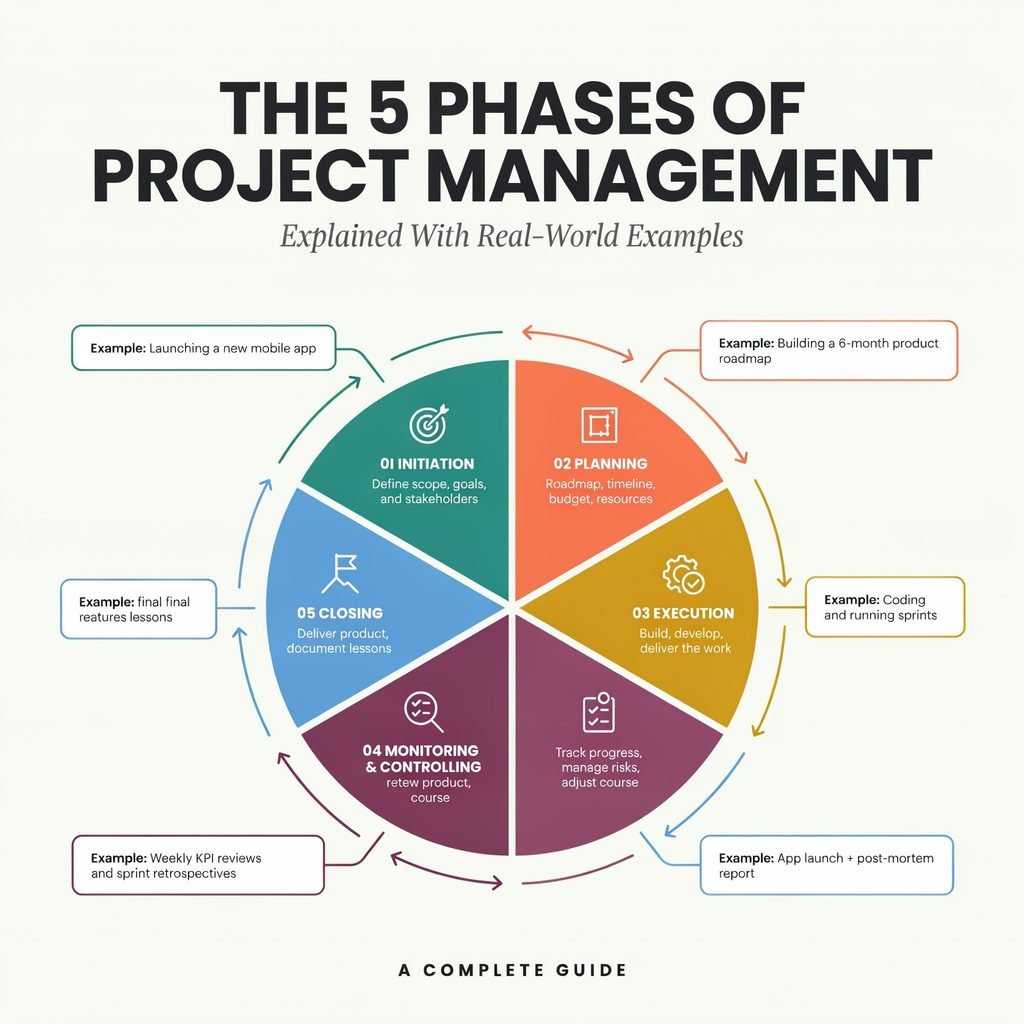
What Are the 5 Phases of Project Management?
The project management lifecycle is the standardized, step-by-step framework used to guide a project from an initial concept to final completion. Think of it as the ultimate roadmap for turning a business vision into a tangible reality.
While different industries have their own unique quirks, the traditional predictive model—often referred to as the PMBOK 5 phases or project management process groups—relies on these core project life cycle stages:
- Initiation: Decide if the project is worth doing and define its high-level purpose.
- Planning: Map out exactly how you will achieve your goals, step by step.
- Execution: Do the actual work and create the physical or digital project deliverables.
- Monitoring & Controlling: Track progress, manage changes, and keep everything aligned with the plan.
- Closure: Finish the work, hand it over to the end-users, and learn from the experience.
It is important to note that these project management phases are not always strictly linear. For example, the monitoring and controlling phase actually runs in parallel with the execution phase. You are constantly tracking, measuring, and adjusting the work while it is actively being done.
Phase 1 – Initiation: Defining the Project
Purpose of the Initiation Phase
The initiation phase project management stage is all about answering one critical question: “Should we do this project?” Before you spend valuable time and money, you must validate the business case. This phase focuses on defining the project at a high level, establishing initial project governance, and securing formal approval to proceed.
Key Activities
- Identify the core business need, problem, or opportunity.
- Define high-level goals and project success criteria.
- Conduct a basic stakeholder analysis to identify key players, end-users, and the project sponsor.
- Assess feasibility regarding high-level budget, time, resources, and potential roadblocks.
- Draft a project charter to formalize the project’s existence and the project manager’s authority.
Key Deliverables
- Project Charter: A short, foundational document that formally authorizes the project.
- Initial Stakeholder List: A register of everyone impacted by or able to influence the project.
- High-Level Business Case: A problem statement or opportunity summary justifying the financial investment.
Example: Software Launch
Imagine a SaaS company noticing high user churn. In the initiation phase, they define the problem and outline expected benefits (e.g., a 10% reduction in churn by adding a requested analytics dashboard). They identify stakeholders across product, engineering, and customer support, and draft a one-page charter to get leadership sign-off before writing a single line of code.
Example: Construction Project
In a commercial construction project, like building a new retail store, initiation involves securing land permits, confirming zoning approvals, and proving the location will generate enough foot traffic to justify the physical build.
Common Mistakes to Avoid
- Starting work early: Jumping into execution before getting formal approval leads to wasted effort if the project gets canceled or pivots.
- Vague objectives: Saying “improve customer satisfaction” without specific metrics makes it impossible to measure success later.
- Missing key stakeholders: Forgetting to consult a vital department (like legal, IT security, or compliance) early on can cause massive, expensive delays down the road.
Phase 2 – Planning: Building the Roadmap
Purpose of the Planning Phase
If initiation is deciding where you are going, the planning phase project management stage is figuring out how you will get there. This is often the most time-consuming phase, as you turn a high-level vision into a highly detailed, actionable roadmap that will guide the entire team.
Key Activities
- Define Scope: Clearly document what is included in the project and, just as importantly, what is explicitly out of scope.
- Create a WBS: Develop a work breakdown structure (WBS) to break the overarching project into smaller, manageable tasks and work packages.
- Estimate Resources: Calculate the time, cost, and personnel needed for each individual task.
- Build a Schedule: Create a visual timeline using a Gantt chart to map out dependencies and milestones.
- Identify Risks: Brainstorm potential issues and log them in a risk register, complete with mitigation strategies.
- Plan Communications: Decide who gets what updates, how often, and through which channels.
- Set Quality Standards: Define the strict acceptance criteria for your project deliverables.
Key Deliverables
- Detailed Project Plan: The master document guiding all execution efforts.
- Work Breakdown Structure (WBS): A hierarchical decomposition of the total scope of work.
- Schedule and Budget Baselines: The approved versions of your timeline and costs used for comparison later.
- Risk Register: A living document tracking identified risks and planned responses.
- Communication and Resource Plans: Guidelines for team coordination and stakeholder updates.
Example: Software Launch
Continuing with our SaaS feature, planning involves defining specific user stories and feature requirements. The engineering team estimates the hours needed, resulting in a 10-week timeline mapped on a Gantt chart. The team also identifies risks—such as potential delays from a third-party API provider—and agrees on weekly status updates for stakeholders.
Common Mistakes to Avoid
- Over-optimistic timelines: Assuming everything will go perfectly leads to immediate schedule slippage. Always build in a contingency buffer.
- Ignoring risks: Hoping for the best is not a strategy. Failing to create a risk register leaves you blind to obvious threats.
- No change-control process: If you don’t define how scope changes are requested and approved upfront, you will inevitably suffer from scope creep.
Phase 3 – Execution: Doing the Work
Purpose of the Execution Phase
The execution phase project management stage is where the rubber meets the road. The planning is done, and the team is finally doing the actual work to create the project deliverables. During this time, the project manager responsibilities shift heavily from planner to facilitator, unblocker, and team leader.
Key Activities
- Assign Tasks: Distribute work packages to team members based on the resource plan.
- Manage Workload: Monitor team capacity to prevent burnout and ensure steady progress.
- Create Deliverables: Write the code, design the graphics, pour the concrete, or draft the marketing copy.
- Hold Status Meetings: Run daily stand-ups or weekly syncs to keep the team aligned and focused.
- Implement Quality Checks: Test increments of work to ensure they meet the acceptance criteria defined in planning.
- Manage Expectations: Keep stakeholders engaged and informed about the day-to-day progress.
Key Deliverables
- Completed Work Packages: The actual physical or digital products being built.
- Status Reports: Regular updates detailing what was accomplished, what is next, and any active blockers.
- Updated Task Boards: Real-time trackers (like Kanban boards) showing task progression.
Example: Software Launch
For the SaaS company, execution is in full swing. Engineers are building the new dashboard feature, designers are finalizing the UI components, and QA is testing early increments. The project manager runs weekly syncs, removes blockers for the dev team, and shares bi-weekly progress demos with the executive sponsors.
Example: Construction Project
In a commercial construction project, this is the phase where heavy machinery breaks ground, steel frames are erected, and subcontractors are actively managed on-site to ensure safety, compliance, and adherence to the blueprints.
Common Mistakes to Avoid
- Poor communication: Silos form when teams don’t talk to each other, leading to duplicated effort or conflicting work.
- Ignoring change requests: If a stakeholder asks for “just one small tweak” and you do it without logging it, you disrupt the schedule and budget.
- Team overload: Failing to manage resources properly leads to burnout, careless mistakes, and high turnover.
Phase 4 – Monitoring & Controlling: Keeping the Project on Track
Purpose of the Monitoring and Controlling Phase
While execution is about doing the work, the monitoring and controlling phase is about ensuring the work is done correctly. This phase runs simultaneously with execution. Its primary goal is to compare actual performance against the baselines set during planning. You are constantly asking: “Are we on track? If not, what corrective action do we take?”
Key Activities
- Track Progress: Measure actual schedule and spend against your baseline plan.
- Measure KPIs: Monitor project metrics and KPIs like percent complete, cost variance, and defect rates.
- Manage Change Control: Review formal change requests, assess their impact on scope, schedule, and budget, and approve or reject them.
- Update Risks: Monitor known risks, trigger response plans if they occur, and identify new risks as the project evolves.
- Report Status: Provide transparent dashboards and reports to project governance boards and key stakeholders.
Key Deliverables
- Performance Reports: Dashboards highlighting KPIs and overall project health.
- Change Logs: A strict record of all requested changes and their approval status.
- Updated Baselines: Revised schedules or budgets reflecting approved changes.
- Risk Updates: Documentation of triggered risks and new mitigation actions.
Example: Software Launch
Midway through the SaaS build, the team realizes a necessary database integration will take two weeks longer than expected. The project manager logs a formal change request, calculates the impact on the launch date and budget, and presents this to the stakeholders. Once approved, the schedule baseline is updated, and the team adjusts their sprint goals.
Common Mistakes to Avoid
- Passive reporting: Simply sending out a status report that says “we are behind” is not enough. You must propose and implement corrective actions.
- Informal scope creep: Allowing small, undocumented favors for stakeholders eventually derails the entire project timeline.
- Ignoring early warnings: If your defect rate is rising or milestones are slipping slightly, address the root cause immediately before it becomes a crisis.
Phase 5 – Closure: Finishing and Learning
Purpose of the Project Closure Phase
The project closure phase is the final stage of the project management lifecycle. It is not just about stopping work; it is about formally ending the project, ensuring all deliverables are accepted, and capturing valuable insights. This phase answers: “Did we deliver the promised value, and what can we learn for next time?”
Key Activities
- Obtain Final Acceptance: Get formal sign-off from the sponsor or client confirming the deliverables meet the agreed-upon criteria.
- Complete Handover: Transfer the final product to the operations or maintenance team, including all necessary training and documentation (project handover).
- Release Resources: Free up your team members, close out vendor contracts, and pay final invoices.
- Conduct a Retrospective: Hold a “lessons learned” session to discuss what went well and what needs improvement.
- Archive Files: Organize and store all project documents, financial records, and templates for future reference.
- Celebrate: Recognize the team’s hard work and celebrate the milestones achieved.
Key Deliverables
- Final Acceptance Document: Formal sign-off indicating project completion.
- Lessons-Learned Report: A summary of successes, failures, and recommendations for future projects.
- Project Handover Documentation: User manuals, admin credentials, and training materials.
- Closure Memo: A final communication to all stakeholders officially announcing the project’s end.
Example: Software Launch
The new SaaS dashboard is successfully deployed to users. The project manager ensures the customer support team is fully trained and the knowledge base is updated. Next, the PM hosts a retrospective with the dev and design teams to document lessons learned. Finally, leadership signs off on the final project report, and the team is officially released to work on new initiatives.
Common Mistakes to Avoid
- Skipping the retrospective: Rushing to the next project without reflecting prevents your organization from improving its processes.
- Poor documentation: Failing to archive files means the next team will have to reinvent the wheel when they maintain or update the product.
- Zombie projects: Leaving a project “kind of done” without formal sign-off leaves lingering budget drains and confused stakeholders.
How the 5 Phases of Project Management Work Together (End-to-End Example)
To see how these project life cycle stages connect in the real world, let’s look at a cohesive marketing example: Launching a Q4 Eco-Friendly Sneaker Campaign.
- Initiation: The marketing director identifies a market opportunity for sustainable footwear. They draft a brief project charter outlining a goal to generate $500k in new revenue and secure executive approval to proceed.
- Planning: The team defines the campaign scope (social media ads, influencer partnerships, and an email drip sequence). They build a work breakdown structure, allocate a $50k budget, and create a Gantt chart mapping out content creation, ad testing, and launch dates.
- Execution: Copywriters write the ad copy, designers shoot the video assets, and the social media manager begins onboarding influencers. The project manager facilitates weekly check-ins to keep the creative team aligned.
- Monitoring & Controlling: Two weeks into the campaign, the project manager notices the cost-per-click on Instagram is 20% higher than planned. They pause the underperforming ads, reallocate the budget to TikTok influencers, and update the risk register.
- Closure: The campaign ends, generating $550k in revenue. The team gathers for a retrospective to document which influencer partnerships drove the highest ROI. All creative assets are archived, and the project is formally closed.
Skipping even one of these phases creates massive risk. If the team had skipped Monitoring, they would have wasted their budget on bad ads. If they skipped Closure, next year’s marketing team wouldn’t know which influencers actually worked.
Best Practices for Applying the 5 Phases
Mastering the project management process groups requires more than just memorizing steps. Here is how to apply this framework effectively in the real world:
- Tailor the Process to Project Size: Not every project needs a 50-page charter. A two-week internal marketing campaign might only require a one-page initiation document and a simple task list, whereas a 12-month enterprise software build requires rigorous governance.
- Leverage Project Management Tools: Use tools that fit your workflow. Asana and Trello are great for visual task management, Jira is ideal for software development, and MS Project or Smartsheet excel at complex Gantt charts and resource leveling.
- Blend Agile and Predictive Methods: Agile vs predictive project management is a common debate, but they can coexist. You can use the traditional 5 phases of project management as your overarching macro-framework (predictive), while executing the actual deliverables using two-week Agile sprints. This hybrid approach offers high-level budget predictability for executives, with day-to-day flexibility for the development team.
- Prioritize Communication: Most project failures are actually communication failures. Over-communicate during the planning and execution stages, and ensure your stakeholders always know the project’s health.
- Embrace Continuous Improvement: Treat the “lessons learned” document from the closure phase as mandatory reading for the initiation phase of your next project.
Conclusion
The 5 phases of project management—Initiation, Planning, Execution, Monitoring & Controlling, and Closure—provide a proven, battle-tested roadmap for turning chaotic ideas into successful realities. By following the PMBOK-aligned project management lifecycle, you drastically reduce risks, eliminate scope creep, and ensure your team is always working toward clearly defined goals.
Whether you are building a software platform, constructing a commercial space, or launching a global marketing campaign, this framework keeps you grounded. Do not leave your project’s success to chance. Start your next initiative by writing a simple project charter today, map it to these five phases, and watch your team deliver with confidence and clarity.