In the modern enterprise, misaligned initiatives and wasted budgets are often symptoms of a single underlying issue: organizational confusion regarding execution strategy. Many leaders use the terms interchangeably, but understanding the nuances of project management vs program management vs portfolio management is critical for operational success. When these three layers are conflated, companies end up executing the wrong work, or executing the right work inefficiently.
To clarify, here is the high-level breakdown:
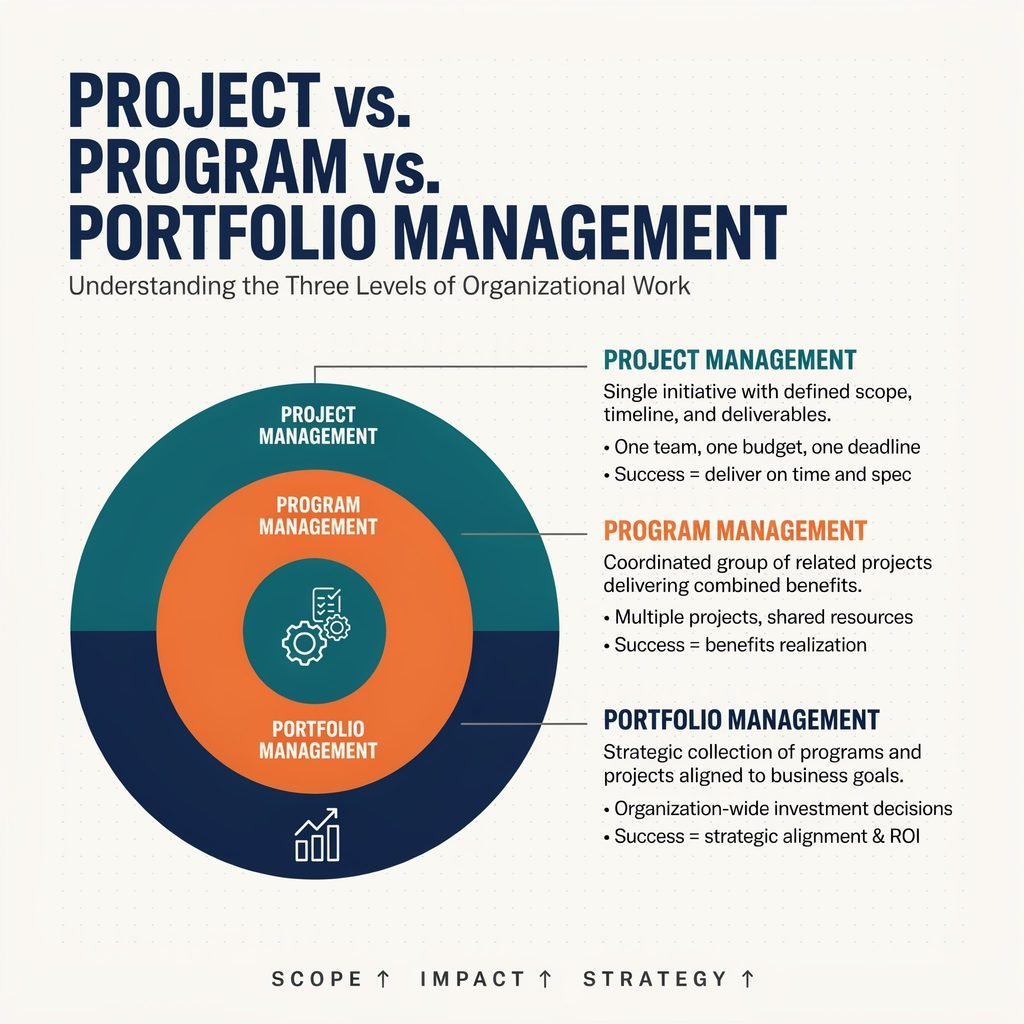
- Project Management focuses on delivering specific outputs and deliverables on time and within budget.
- Program Management coordinates multiple related projects to achieve broader business outcomes and benefits.
- Portfolio Management oversees all projects and programs to ensure strategic alignment, prioritize investments, and maximize ROI.
In this comprehensive guide, we will explore the clear differences, real-world examples, distinct roles, and necessary certifications that define each discipline. Whether you are a PMO leader evaluating PPM tools, an operations professional mapping out a PMO framework, or a manager looking to climb the ranks, this article will show you how these layers fit together to drive enterprise strategy.
What Is Project Management?
At its core, project management is the application of knowledge, skills, tools, and techniques to project activities to meet specific requirements. A project is defined as a temporary endeavor with a defined beginning and end, a specific scope, and allocated resources. It is designed to produce a unique product, service, or result.
The primary objectives of project management are highly tactical: delivering the agreed-upon scope on time, within budget, and to the required quality standards. To achieve this, project managers rely on established frameworks and methodologies. Traditional approaches are often guided by PMI standards (PMBOK) or PRINCE2, which emphasize rigorous project planning and execution, phase gates, and strict change control. Conversely, modern software and IT environments frequently utilize Agile project management frameworks like Scrum or Kanban to iterate quickly and adapt to changing requirements.
The project manager responsibilities are heavily focused on tactical execution and day-to-day team coordination. A project manager handles scheduling, risk management at the task level, stakeholder communication, and resource allocation for their specific initiative. They are the “captains of the ship” for a single vessel, ensuring it reaches its specific destination safely.
Real-World Examples
- SaaS Feature Launch: A software company tasks a team with building and releasing a new AI-driven reporting dashboard. The project scope is strictly defined by the product requirements document, and the project lifecycle ends when the feature is deployed to production.
- CRM Migration: Moving sales data from a legacy system to Salesforce. The project success metrics are based on data integrity, user adoption rates post-launch, and completing the migration before the legacy contract expires.
Ultimately, project management is about doing the work right. It is the foundational layer of execution where abstract ideas are transformed into tangible deliverables.
What Is Program Management?
While a project focuses on specific deliverables, program management is the coordinated management of multiple related projects to achieve broader strategic benefits that would not be possible if they were managed individually. A program is less about producing a single output and more about realizing a significant business outcome.
The defining characteristic of a program is benefits realization. Program managers look past the immediate deliverables of individual projects and focus on how those deliverables integrate to create long-term value. Because they deal with complex organizational change, programs typically have a longer, more fluid timeframe than single projects.
Program manager responsibilities shift away from daily task tracking and toward high-level coordination. A program manager focuses on managing interdependencies between projects, resolving cross-project conflicts, and overseeing program governance. If Project A is delayed, the program manager must assess how that impacts Project B and the ultimate business benefit. They are also responsible for high-level stakeholder management in PPM contexts, ensuring that executive sponsors remain aligned and that the program continues to serve the evolving needs of the business.
Real-World Example
Consider a “Digital Transformation Program” at a mid-sized retail company. This program isn’t a single project; it is a collection of coordinated projects, which might include:
- A website rebuild project.
- A CRM and ERP integration project.
- A supply chain data platform upgrade.
- A company-wide staff training and change management rollout.
If managed strictly as isolated projects, the website might launch before the backend inventory system is updated, leading to a broken customer experience. The program lifecycle ensures these initiatives are synchronized. The program benefits realization is measured not by whether the website was built on time, but by whether overall digital revenue increased and operational costs decreased as a result of the combined efforts.
What Is Portfolio Management?
Moving to the highest level of the hierarchy, portfolio management (PPM) involves managing all projects and programs as a unified collection to maximize strategic value and return on investment (ROI). Unlike a program, the initiatives within a portfolio do not necessarily need to be related to one another; they simply compete for the same finite organizational resources and funding.
Project portfolio management is fundamentally about strategic alignment and capital allocation and project prioritization. It answers the critical executive question: “Are we investing our time, money, and talent in the right initiatives to achieve our corporate goals?” Portfolio management is the embodiment of the philosophy of “doing the right projects.”
The portfolio manager responsibilities (often housed within an Enterprise PMO or EPMO) involve setting investment criteria, evaluating proposed initiatives, balancing risk versus return, and making difficult funding decisions. This includes portfolio selection and prioritization, as well as the continuous monitoring of active work. Crucially, project cancellation and portfolio optimization are key duties; if a project no longer aligns with shifting market conditions or business strategy, the portfolio manager must have the authority to kill it and reallocate resources to higher-value work.
Real-World Example
A global technology company’s annual portfolio might include a diverse mix of initiatives:
- Product Development Programs: Next-generation hardware R&D.
- Infrastructure Projects: Migrating all internal servers to a multi-cloud environment.
- Compliance Initiatives: Achieving SOC2 and GDPR certification across all global offices.
- Market Expansion Projects: Launching localized marketing campaigns in the APAC region.
Through IT project portfolio management or SaaS project portfolio management software, leadership can view the entire landscape, assess portfolio ROI and strategic alignment, and ensure that the aggregate risk of the portfolio does not exceed the company’s risk appetite. This is enterprise portfolio management in action: treating corporate initiatives like an investment portfolio, diversifying risk, and maximizing yield.
Key Differences: Project vs. Program vs. Portfolio Management
To truly grasp the difference between project, program, and portfolio management, it helps to view them side-by-side across several core dimensions.
| Dimension | Project Management | Program Management | Portfolio Management |
|---|---|---|---|
| Scope | Narrow, strictly defined deliverables and tasks. | Broad, encompassing multiple related projects and organizational change. | Enterprise-wide, encompassing all strategic investments across the business. |
| Objective | Deliver specific outputs on time and on budget. | Realize strategic outcomes and business benefits. | Maximize ROI, strategic alignment, and optimal resource utilization. |
| Time Horizon | Short to medium-term (strict start and end dates). | Medium to long-term (fluid, ends when benefits are realized). | Continuous and ongoing (tied to annual/quarterly strategic planning cycles). |
| Focus | Tactical execution (Doing the work right). | Benefits management (Coordinating work for outcomes). | Strategic alignment (Choosing the right work to do). |
| Success Metrics | Scope, schedule, budget, and quality (The Iron Triangle). | ROI, benefit realization, stakeholder satisfaction, and capability adoption. | Aggregate portfolio ROI, strategic goal achievement, and resource optimization. |
| Decision-Making | Task-level and daily team problem solving. | Cross-project conflict resolution and dependency management. | Investment funding, prioritization, and initiative cancellation. |
| Resource Mgmt | Allocating team members to specific project tasks. | Resolving resource conflicts between dependent projects. | Enterprise capacity planning and macro-level resource allocation. |
| Typical Roles | Project Manager, Scrum Master, Project Coordinator. | Program Manager, Benefits Manager, Program Director. | Portfolio Manager, Head of PMO, EPMO Director, C-Suite. |
| Certifications | PMP, PRINCE2, CAPM, CSM (Scrum). | PgMP, PRINCE2 Agile, MSP (Managing Successful Programmes). | PfMP, Certified Portfolio Manager, SAFe Agilist. |
The Hierarchy of Value
The easiest way to remember the project vs program vs portfolio distinction is by looking at the value they create. Projects deliver outputs (e.g., a new software application). Programs deliver outcomes and benefits (e.g., increased customer retention driven by the new software). Portfolios deliver strategy (e.g., capturing 20% market share through a mix of software, marketing, and M&A initiatives).
Project management is about doing projects right. Portfolio management is about doing the right projects. Program management sits in the middle, ensuring related projects combine into the right outcome. A tactical vs strategic PMO understands this implicitly, ensuring that the organization doesn’t just become a highly efficient factory for building things nobody actually needs.
How Project, Program, and Portfolio Management Work Together
These three disciplines do not exist in silos; they form a cohesive project management hierarchy that connects daily execution to the C-suite’s vision. Understanding how project, program, and portfolio management work together is vital for building a mature delivery organization.
Information and strategy flow in a continuous loop across these layers:
- Top-Down (Strategy to Execution): The executive board defines the corporate strategy. The portfolio governance body reviews this strategy and selects/funds the programs and projects that support it. Program managers break these funded initiatives down into coordinated projects. Project managers then execute the daily tasks.
- Bottom-Up (Metrics to Strategy): Project managers report on task completion, budget burn, and immediate risks. Program managers aggregate this data to track progress toward business benefits. Portfolio managers roll this up further to assess overall strategic performance, reallocating capital if a program is failing to deliver its promised ROI.
The Role of the PMO / EPMO
The PMO (Project Management Office) or EPMO (Enterprise PMO) acts as the central nervous system connecting these layers. A modern PMO framework provides the standardized methodologies, PPM tools, templates, and reporting structures that allow data to flow seamlessly from a project’s Jira board up to the portfolio manager’s executive dashboard.
A Real-World Scenario
Imagine a B2B SaaS company whose strategic goal is to “Expand into the Mid-Market SMB segment.”
- Portfolio Level: The EPMO evaluates proposals and approves funding for a “SMB Expansion Program,” prioritizing it over a niche enterprise feature update.
- Program Level: The Program Manager coordinates three distinct tracks: Product (building SMB-specific features), Marketing (launching an SMB lead-gen campaign), and Sales (training reps on SMB pitching).
- Project Level: Individual project managers execute the specific deliverables: the engineering sprint to build the feature, the agency project to shoot commercial assets, and the L&D project to update the sales playbook.
Through strategic project management, the daily coding done by the engineering team is directly tethered to the corporate goal of market expansion.
Roles and Career Paths: Project Manager vs. Program Manager vs. Portfolio Manager
The career path from project manager to program manager to portfolio manager represents a distinct shift in mindset—from managing tasks and teams to managing benefits, finances, and corporate strategy.
The Progression
- Project Coordinator / Junior PM: Focuses on administrative support, scheduling, and tracking action items.
- Project Manager (PM): Owns the delivery of specific initiatives. The focus is on scope, schedule, budget, and team leadership.
- Senior Project Manager: Handles high-risk, high-visibility, or highly complex projects, often mentoring junior PMs.
- Program Manager (PgM): Steps away from daily task management to oversee a group of related projects. Requires strong skills in organizational change management, benefits tracking, and executive stakeholder alignment.
- Portfolio Manager / Head of PMO (PfM): Operates at the enterprise level. This role requires deep financial acumen, strategic planning skills, and the authority to make capital allocation decisions.
Key Certifications
For professionals navigating the project manager vs program manager vs portfolio manager career trajectory, industry-recognized certifications are vital:
- PMP (Project Management Professional): The gold standard for project managers, validating mastery of the PMBOK guide, predictive planning, and Agile principles.
- PgMP (Program Management Professional): A highly advanced PMI certification for program managers, focusing heavily on strategy alignment, benefits management, and complex stakeholder engagement.
- PfMP (Portfolio Management Professional): The pinnacle of PMI certifications, designed for executives and portfolio managers who oversee strategic investment and organizational governance.
- Alternative Frameworks: PRINCE2 vs PMP is a common debate, with PRINCE2 being highly prevalent in the UK and Europe. Additionally, as companies adopt Lean-Agile methodologies at scale, certifications in SAFe (Scaled Agile Framework) are becoming crucial for Agile portfolio management and large-scale program delivery.
While project managers are compensated for reliable execution, program and portfolio managers command higher salaries due to their direct impact on the company’s financial health and strategic trajectory.
When to Use Each Approach in Your Organization
Knowing when to use project vs program vs portfolio management depends heavily on your organization’s size, maturity, and the complexity of the work at hand.
- Use Project Management for discrete, well-defined initiatives with clear boundaries. If you need to upgrade a specific server, host an annual user conference, or launch a minor software update, a standalone project managed by a certified PM is the right approach.
- Use Program Management when multiple projects must be heavily coordinated to achieve a major strategic outcome, especially when the work involves significant organizational change. If you are merging with another company, overhauling your entire supply chain, or executing a multi-year digital transformation, you need a program manager to handle the complex interdependencies.
- Use Portfolio Management when leadership needs to prioritize across all initiatives, allocate limited budgets, and ensure alignment with corporate strategy. If your company has 50 different “pet projects” running simultaneously but revenue is stagnating, you need portfolio governance to prioritize the high-value work and kill the rest.
Organizational Context
- Startups: Typically operate almost entirely at the project level. Everyone is focused on immediate execution and survival. Program and portfolio thinking is usually informal and handled directly by the founders.
- Scale-ups: As headcount and revenue grow, informal project portfolio management becomes necessary. Leadership begins to form emerging programs to coordinate cross-functional product launches.
- Enterprises: Require a formal PMO or EPMO. Enterprise portfolio management is strictly governed, utilizing advanced portfolio management software to track capital allocation, risk, and strategic alignment across thousands of global employees.
Common Mistakes and How to Avoid Them
Even mature organizations stumble when managing the project management hierarchy. Here are common pitfalls and how to fix them:
- Mistake: Treating every initiative as a “project.”
- The Fix: Recognize when a massive, multi-year organizational change is actually a program. Applying strict project management constraints to a fluid program will stifle the adaptability needed to realize actual business benefits.
- Mistake: Running “Zombie Projects” that don’t align with strategy.
- The Fix: Implement strict portfolio prioritization and regular portfolio review boards. If a project no longer serves the current corporate strategy, the EPMO must have the authority to cancel it and reallocate the budget.
- Mistake: Confusing Program Management with “just bigger Project Management.”
- The Fix: Shift the focus from deliverables to benefits. A program manager shouldn’t just be tracking Gantt charts; they should be tracking user adoption, revenue impact, and operational efficiency.
- Mistake: Operating a “Reporting-Only” PMO.
- The Fix: Evolve from an operational vs strategic PMO. A PMO shouldn’t just collect status reports; it should actively guide strategic alignment of projects and programs, provide coaching, and optimize resource capacity.
- Mistake: Ignoring enterprise resource capacity.
- The Fix: Utilize PPM tools to view resource utilization across the entire portfolio. Approving 20 high-priority projects means nothing if you only have the engineering capacity to execute five of them.
Frequently Asked Questions (FAQ)
What is the main difference between project, program, and portfolio management?
The difference between project program and portfolio management lies in their focus. Project management focuses on tactical execution and delivering specific outputs. Program management focuses on coordinating related projects to achieve strategic business benefits. Portfolio management focuses on selecting and prioritizing all initiatives to maximize ROI and strategic alignment.
Is PMP enough, or should I pursue PgMP and PfMP?
The PMP is the essential baseline for anyone managing projects. However, if your career goal is to manage large-scale, cross-functional initiatives or oversee enterprise investments, pursuing the PgMP or PfMP is highly recommended. These advanced certifications validate your ability to handle PMP vs PgMP vs PfMP level complexities, such as benefits realization and capital allocation.
Can one person handle project, program, and portfolio management in a small company?
Yes, in startups and small businesses, a “Head of Operations” or “Director of PMO” often wears all three hats. However, as the company scales, this becomes a bottleneck. The mindset required to manage a daily sprint (Project) is vastly different from the mindset required to evaluate annual capital investments (Portfolio).
How does a PMO fit into project, program, and portfolio management?
A PMO provides the framework, tools, and governance that connect the layers. To understand how PMO supports project program and portfolio management, think of the PMO as the central hub: it provides templates for project managers, tracks benefits for program managers, and supplies data analytics to portfolio managers for strategic decision-making.
What are typical success metrics for each level?
Project success is measured by the Iron Triangle (on time, on budget, within scope). Program success is measured by benefits realization (e.g., increased market share, reduced operational costs). Portfolio success is measured by aggregate ROI, strategic goal achievement, and optimal resource utilization.
Is Agile compatible with program and portfolio management?
Absolutely. Agile portfolio management and Agile program management (often facilitated by frameworks like SAFe or LeSS) are increasingly popular. Instead of rigid annual funding, Agile portfolios fund “value streams” or strategic themes, allowing teams to pivot dynamically based on continuous feedback and market changes.
Final Thoughts
The debate of project management vs program management vs portfolio management is not about choosing one over the others; it is about understanding how these three complementary layers work in concert. Projects are the engines of execution, programs are the steering mechanisms that ensure those engines drive toward a unified outcome, and the portfolio is the map that ensures the entire fleet is heading toward the right destination.
Mature organizations intentionally design all three layers. They invest in project management certifications to ensure tactical excellence, empower program managers to drive organizational change, and rely on portfolio managers to safeguard strategic investments. As companies adopt more complex initiatives, navigate global market shifts, and integrate AI-driven PPM tools, the clear distinctions between these disciplines will become even more critical to survival and growth.
If you’re building or scaling a PMO, start by clarifying which layer each initiative belongs to. Ensure your projects are managed tightly, your programs are focused on benefits, and your portfolio is relentlessly aligned with your ultimate business strategy.