You just landed your first project management role, or perhaps you’re a career switcher prepping for your CAPM exam. You walk into a kickoff meeting, grab your coffee, and suddenly you’re bombarded with acronyms and jargon. Someone mentions the “WBS,” asks for an update on the “critical path,” and demands a revised “RACI matrix” before lunch. If your head is spinning and you feel like you’ve accidentally walked into a foreign language class, don’t panic.
It’s completely normal to feel overwhelmed by project management terms when you’re just starting out. Every specialized industry has its own language, and project management—with its blend of business strategy, psychology, and tactical execution—is notoriously jargon-heavy.
This comprehensive new project manager guide decodes 28 must-know terms so you can follow high-level conversations, contribute confidently in status meetings, and dramatically accelerate your learning curve. Project management isn’t a one-size-fits-all discipline. The terms in this PM glossary span traditional (Waterfall) approaches, modern Agile frameworks, and increasingly popular Hybrid methodologies. Whether you are building enterprise software or organizing a global marketing campaign, mastering this project management vocabulary is your first step toward success.
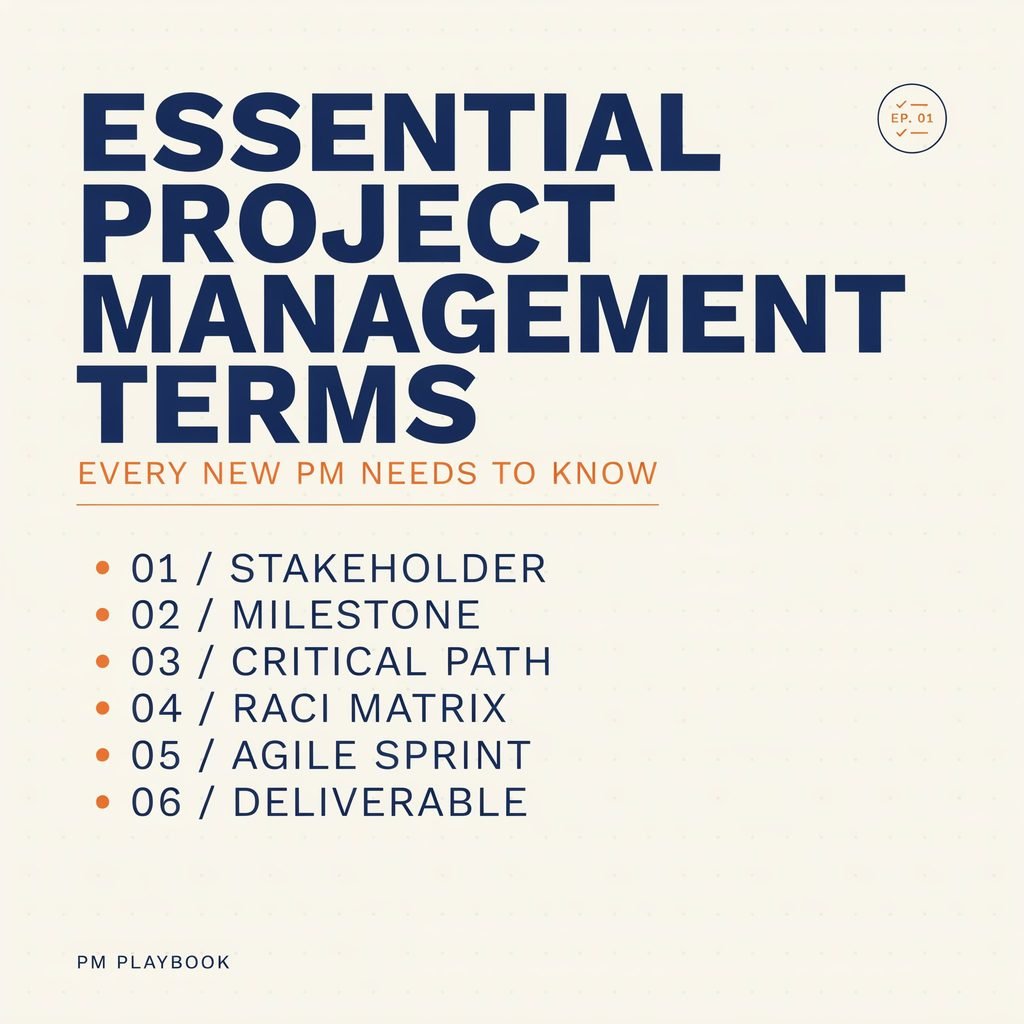
Why Learning PM Terminology Matters
A shared project management vocabulary is the invisible glue that holds cross-functional teams, vendors, and executive sponsors together. When everyone speaks the exact same language, it drastically improves team alignment, reduces costly miscommunication, and speeds up the onboarding process for new hires. Imagine the confusion of telling your development team to “fix the thing” versus precisely asking them to “resolve the blocker in the sprint backlog.” Precision matters, and it saves countless hours of rework.
Furthermore, if you are eyeing industry-recognized certifications like the Certified Associate in Project Management (CAPM) or the prestigious Project Management Professional (PMP) credential, mastering these essential PM terms isn’t just optional—it’s absolutely mandatory. These rigorous exams, heavily based on the Project Management Body of Knowledge (PMBOK® Guide) and standards like PRINCE2, test your understanding of framework logic and standard terminology.
Even if you aren’t actively pursuing project management for beginners certifications right now, knowing the lingo builds instant, undeniable credibility with your stakeholders. When you can effortlessly discuss “scope creep,” “earned value,” and “risk mitigation” in a steering committee meeting, you signal to leadership that you are a competent professional capable of steering complex initiatives from successful initiation to final closure.
Core Project Management Terms
Planning & Scope
- Project Charter: A formal, foundational document that officially authorizes a project’s existence and outlines its high-level objectives, preliminary scope, and key stakeholders. Why it matters: It provides the project manager with the formal authority to apply organizational resources, budget, and personnel to project activities. Example: Before a retail company invests $2M into a new mobile app, the executive steering committee signs a project charter defining the strategic goals, budget constraints, and target launch window.
- Scope / Scope Statement: A highly detailed description of the project’s specific deliverables, boundaries, acceptance criteria, and the exact work required to create them. Why it matters: It sets crystal-clear expectations and acts as a shield against unauthorized work, ensuring the team doesn’t waste time on out-of-bounds requests. Example: The scope statement for a corporate website redesign specifies that it includes the homepage and blog revamp, but explicitly excludes the e-commerce checkout portal and mobile app integration.
- Deliverables: Tangible or intangible goods, services, or results that must be produced to complete a project or a specific phase of a project. Why it matters: They are the measurable, verifiable outputs that prove progress is being made and value is being delivered to the client. Example: For a B2B marketing campaign project, key deliverables might include finalized ad copy, three distinct graphic design variations, and a published social media content calendar.
- Work Breakdown Structure (WBS): A visual, hierarchical decomposition of the total scope of work into smaller, highly manageable components known as work packages. Why it matters: It ensures no critical tasks are overlooked during planning and makes estimating costs, resources, and time significantly more accurate. Example: When planning an annual corporate conference, the WBS breaks the massive “Catering” deliverable down into menu selection, dietary restriction data collection, and final vendor payment processing.
- Milestones: Significant, zero-duration points or events in the project schedule that mark the successful completion of a major phase, deliverable, or decision gate. Why it matters: They act as crucial progress checkpoints for executive stakeholders and help the team track high-level momentum without getting bogged down in daily tasks. Example: “Final Architectural Design Approval” is a critical milestone; it has no duration itself, but it signifies the construction team can finally break ground.
- Baseline: The original, formally approved project plan (for scope, schedule, or cost) used as a fixed benchmark to measure actual performance and variance over time. Why it matters: You cannot accurately determine if a project is over budget or behind schedule if you do not have a rigid, original target to compare against. Example: The schedule baseline was set for a strict 6-month development timeline; if the project actually finishes in 7 months, the PM reports a negative schedule variance against the baseline.
- Scope Creep: The uncontrolled, continuous expansion or gradual change to a project’s scope without corresponding adjustments to time, budget, or resources. Why it matters: It is widely considered one of the leading causes of project failure, severe budget overruns, and ultimate team burnout. Example: A client casually asks the software team to “just add a quick AI chat feature” after the design phase is locked, unknowingly derailing the entire testing timeline.
- Change Request: A formal, documented proposal to modify any project document, deliverable, or established baseline. Why it matters: It ensures all proposed changes are rigorously evaluated for impact, documented, and approved through a structured change control board (CCB) process. Example: A lead developer submits a formal change request to swap database vendors because the current solution lacks necessary compliance features, requiring the PM to assess the cost and schedule impact.
Scheduling & Execution
- Critical Path: The absolute longest sequence of dependent tasks in a project plan that must be completed precisely on time for the project to finish by its final deadline. Why it matters: Any delay on a critical path task directly and mathematically delays the entire project completion date, leaving zero float or slack. Example: In building a custom home, pouring the foundation, framing, and roofing are on the critical path; picking interior paint colors has float and is not.
- Gantt Chart: A highly visual horizontal bar chart that illustrates a detailed project schedule, showing task start and end dates, durations, overlaps, and dependencies. Why it matters: It provides an intuitive, high-level timeline view that helps teams visualize overlapping tasks and helps PMs communicate the plan to non-technical stakeholders. Example: A project manager uses a Gantt chart to show the executive board that the marketing launch tasks will heavily overlap with the final weeks of QA testing.
- Dependencies: The logical relationships between project tasks, determining the strict order in which they must be performed (e.g., Finish-to-Start, Start-to-Start, Finish-to-Finish, Start-to-Finish). Why it matters: Mapping dependencies ensures tasks aren’t started prematurely before their prerequisite work is completed, preventing rework and wasted effort. Example: You have a Finish-to-Start (FS) dependency where you absolutely cannot “Paint the drywall” until the team has finished “Install the drywall.”
- Resource Allocation: The strategic process of assigning and managing an organization’s resources—people, equipment, software, and budget—to specific project tasks. Why it matters: It prevents team burnout, avoids costly overallocation, and ensures the right specialized skills are applied to the most critical tasks. Example: A PM strategically allocates the senior UX designer exclusively to the checkout flow revamp for two weeks to ensure the highest quality output for a high-stakes feature.
- Bottleneck: A point of severe congestion in a system, process, or workflow that drastically slows down the overall project progress. Why it matters: Identifying bottlenecks early allows the PM to reallocate resources, optimize processes, and smooth out the workflow to maintain momentum. Example: If only one senior architect can approve code merges, they become a severe bottleneck, and the rest of the development team sits idle waiting for their review.
- Stand-up (Daily Scrum): A brief, highly focused daily alignment meeting (usually strictly capped at 15 minutes) where the team discusses what they did yesterday, what they will do today, and any blocking impediments. Why it matters: It fosters daily communication, quickly surfaces hidden blockers, and keeps the entire team accountable to their sprint commitments. Example: During the morning stand-up, a developer flags that a missing third-party API key is blocking their progress, prompting the tech lead to escalate and fix it immediately.
- Sprint: A fixed, time-boxed period (usually ranging from 1 to 4 weeks) in Agile frameworks during which a specific, usable, and potentially shippable increment of work is completed. Why it matters: It breaks massive, overwhelming projects into highly digestible chunks, allowing for rapid iteration, regular feedback, and continuous delivery of value. Example: The development team commits to delivering the user login, password reset, and profile features during the current two-week sprint, ignoring all other feature requests until it ends.
- Backlog: A dynamic, continuously prioritized list of all desired tasks, features, bug fixes, and technical requirements that need to be addressed for the product or project. Why it matters: It serves as the single, evolving source of truth for what the team should work on next, ensuring absolute alignment with shifting business priorities. Example: The product owner moves a critical security patch to the very top of the product backlog so the engineering team tackles it immediately in the next sprint.
Risk, Governance & Control
- Stakeholders: Any individual, group, or organization that can affect, be affected by, or perceive itself to be affected by a project’s decisions, activities, or outcomes. Why it matters: Identifying, analyzing, and engaging stakeholders early ensures their needs are met, secures necessary buy-in, and mitigates political resistance. Example: For a corporate office relocation project, key stakeholders include the employees moving, the facilities management team, the commercial landlords, and the executive board.
- RACI Matrix: A highly effective chart that clarifies roles and responsibilities for specific project tasks, indicating who is Responsible (does the work), Accountable (owns the outcome), Consulted (provides input), and Informed (kept in the loop). Why it matters: It completely eliminates confusion and turf wars about who is actually doing the work versus who just needs to be notified of progress. Example: In a RACI matrix for publishing a corporate blog post, the copywriter is Responsible, the marketing director is Accountable, the subject matter expert is Consulted, and the CEO is Informed.
- Risk Register: A centralized, living document or database used to proactively identify, track, and manage potential project risks, including their probability, impact, and planned mitigation strategies. Why it matters: It transforms reactive, stressful firefighting into proactive, strategic risk management, saving time and money in the long run. Example: The risk register notes that a critical hardware supplier might go out of business, and the mitigation plan is to pre-qualify and contract a backup vendor immediately.
- RAID Log: A comprehensive project management tracking tool used to monitor Risks, Assumptions, Issues, and Dependencies in one centralized location. Why it matters: It provides a holistic, 360-degree view of project health and governance, ensuring no critical administrative details slip through the cracks during execution. Example: During a weekly steering committee meeting, the PM reviews the RAID log to demonstrate how a newly discovered assumption about new data privacy laws impacts the testing timeline.
- Issue vs. Risk: A risk is an uncertain future event that might impact the project objectives, whereas an issue is a current, realized problem that has already happened and requires immediate resolution. Why it matters: The response strategies fundamentally differ; you proactively mitigate and avoid risks, but you must reactively resolve and manage issues. Example: A potential hurricane forming in the Atlantic is a risk; the severe power outage caused by the hurricane that just hit your primary data center today is a critical issue.
- Earned Value Management (EVM): A rigorous, quantitative technique that integrates scope, schedule, and resource measurements to objectively assess project performance and progress. Key metrics include Planned Value (PV), Earned Value (EV), Actual Cost (AC), Schedule Variance (SV), and Cost Variance (CV). Why it matters: It provides objective, mathematically sound insights into whether you are truly on track, rather than relying on subjective gut feelings or optimistic estimates. Example: If your Earned Value (the budgeted cost of work actually performed) is significantly lower than your Actual Cost, your project is currently over budget and burning cash too fast.
- KPIs / OKRs: Key Performance Indicators (KPIs) are quantifiable, measurable values demonstrating how effectively a team is achieving key operational objectives, while Objectives and Key Results (OKRs) are a strategic goal-setting framework used to define and track ambitious, qualitative outcomes. Why it matters: They ensure the project’s daily outputs are tightly aligned with overarching business strategy and measure true market success beyond just finishing on time. Example: A KPI for a software launch might be “system uptime of 99.99%,” while a strategic OKR might be “Increase 30-day user retention by 15% in Q3.”
Agile & Hybrid Frameworks
- Agile: A highly iterative, flexible approach to project management and software development that heavily emphasizes cross-functional collaboration, rapid customer feedback, and adapting to change over following a rigid plan. Why it matters: It allows teams to deliver incremental value much faster and pivot quickly when market demands or customer needs inevitably shift. Example: Instead of waiting a full year to launch a massive, complex e-commerce site, an Agile team releases a basic shopping cart first and iteratively adds advanced features based on real user behavior.
- Scrum: A specific, highly structured, and widely used Agile framework that utilizes fixed-length sprints, specific roles (Scrum Master, Product Owner, Developers), and mandatory ceremonies to deliver work. Why it matters: It provides a clear, predictable rhythm and a strict set of rules for teams to self-organize, collaborate effectively, and continuously improve their velocity. Example: A Scrum team holds a detailed sprint planning meeting on Monday morning and a comprehensive sprint review and demo with stakeholders on Friday afternoon.
| Ceremony | Purpose | Frequency / Timing |
|---|---|---|
| Sprint Planning | To define what can be delivered in the sprint and how that work will be achieved. | Day 1 of the Sprint |
| Daily Stand-up | To synchronize activities, plan for the next 24 hours, and surface any blockers. | Daily (15 mins) |
| Sprint Review | To inspect the increment, adapt the backlog, and demo completed work to stakeholders. | Last day of the Sprint |
| Sprint Retrospective | To reflect on the past sprint and identify actionable process improvements for the next one. | After the Review |
| Backlog Refinement | To review, update, and estimate upcoming backlog items to ensure they are ready for future sprints. | Ongoing / Mid-Sprint |
- Kanban: A highly visual workflow management method focused on continuous delivery and maximizing efficiency without overburdening the team, typically utilizing a board with columns (e.g., To Do, In Progress, Review, Done). Why it matters: It makes workflow bottlenecks instantly visible and limits work-in-progress (WIP) to drastically improve focus, quality, and overall throughput. Example: The IT helpdesk support team uses a Kanban board to track incoming employee tickets, smoothly moving cards from “Triage” to “In Progress” to “Resolved” as agents complete them.
- Waterfall: A traditional, highly linear, and strictly sequential approach to project management where each distinct phase (requirements, design, implementation, testing, deployment) must be fully completed and approved before the next phase begins. Why it matters: It provides high predictability, rigorous documentation, and strict change control, making it ideal for physical construction, manufacturing, or highly regulated industries. Example: An aerospace engineering company uses Waterfall to build a satellite, because you absolutely cannot start testing the rocket engines before the structural blueprints are fully approved and locked.
- Hybrid Methodology: A highly flexible, blended approach that strategically combines elements of both predictive (Waterfall) and adaptive (Agile) frameworks to suit the unique needs of a complex project. Why it matters: It offers the high-level budget and timeline predictability that executives and finance teams crave, while allowing the development team the flexibility to iterate on the actual product. Example: A company uses Waterfall to secure funding and define physical hardware specifications, but seamlessly uses Agile Scrum for the accompanying software application development.
- Velocity: A crucial Agile metric that measures the exact amount of work (usually tracked in story points) a development team successfully completes and gets approved during a single sprint. Why it matters: It helps teams and product owners accurately forecast how much complex work they can realistically commit to in future sprints, preventing overcommitment. Example: If a team’s average velocity over the last three consecutive sprints is 40 story points, the Product Owner will not plan for an unrealistic 60 points in the upcoming sprint.
- Burndown Chart: A simple, graphical representation of the total work left to do versus time, visually showing the team’s actual daily progress against their planned sprint or project completion rate. Why it matters: It provides an immediate, highly visible early warning system if the team is falling behind their sprint commitments and needs to adjust scope or address blockers. Example: On day five of a ten-day sprint, the burndown chart line is completely flat, indicating the team hasn’t completed any story points and urgently needs to address technical blockers.
- Retrospective: A dedicated, psychologically safe meeting held at the very end of an Agile sprint or major project phase where the team reflects deeply on what went well, what didn’t, and how they can improve their internal processes. Why it matters: It is the primary engine for continuous improvement, team bonding, and preventing the repetition of costly mistakes in future work cycles. Example: During the sprint retrospective, the development team agrees to implement a stricter code-review checklist because minor bugs were slipping through into the production environment.
Common PM Acronyms Quick Reference
When you are deep in the weeds of project governance and stakeholder engagement, you will encounter acronyms daily. Keep this compact table handy to quickly decode the most common abbreviations used across both traditional and Agile environments.
| Acronym | Full Term | One-Line Definition |
|---|---|---|
| WBS | Work Breakdown Structure | A hierarchical breakdown of project deliverables into manageable work packages. |
| RACI | Responsible, Accountable, Consulted, Informed | A matrix clarifying team roles and responsibilities for specific tasks. |
| SOW | Statement of Work | A formal document defining project-specific activities, deliverables, and timelines for a vendor. |
| EVM | Earned Value Management | A technique integrating scope, schedule, and cost to measure project performance. |
| PV | Planned Value | The estimated budgeted value of the work planned to be completed by a certain date. |
| EV | Earned Value | The estimated value of the work actually accomplished to date. |
| AC | Actual Cost | The actual costs incurred for the work completed thus far. |
| SV | Schedule Variance | A measure of schedule performance, calculated as EV minus PV. |
| CV | Cost Variance | A measure of cost performance, calculated as EV minus AC. |
| RAID | Risks, Assumptions, Issues, Dependencies | A log used to track critical project elements and potential roadblocks. |
| KPI | Key Performance Indicator | A measurable metric used to evaluate the success of a project or activity. |
| OKR | Objectives and Key Results | A goal-setting framework used to define and track ambitious business outcomes. |
Tips for New PMs to Master the Lingo
Learning a new vocabulary takes time, patience, and consistent practice. Here are practical, actionable strategies to integrate these project management terms into your daily professional routine:
- Keep a personal glossary: Maintain a dedicated digital notebook (like Notion, Evernote, or OneNote) strictly for PM terms. When you hear an unfamiliar acronym in a leadership meeting, jot it down quickly and look it up later to build your own customized PM glossary.
- Ask clarifying questions: Never be afraid to ask for clarity in meetings. You can confidently say, “Just to make sure we are perfectly aligned, when you mention the baseline today, are you referring to the scope baseline or the schedule baseline?” People deeply respect PMs who prioritize precision over pretending to know everything.
- Use templates in action: The absolute best way to learn terms like RACI matrix, project charter, or risk register is to actively use them. Download standard PMI or Smartsheet templates and fill them out for your current projects, or even practice by using them to plan a complex personal event like a wedding or home renovation.
- Immerse yourself in PM communities: Follow active communities like the r/projectmanagement subreddit, PM-focused Substack newsletters, or specialized LinkedIn groups. Reading real-world discussions and war stories will expose you to how these essential PM terms are used casually, practically, and professionally in the wild.
- Prepare for certifications: If you are actively studying for the CAPM or PMP exams, use spaced-repetition flashcard apps like Anki or Quizlet. Drilling terms and formulas daily builds crucial muscle memory that serves you well on the exams and in your day-to-day application.
Conclusion
Becoming truly fluent in project management terms doesn’t happen overnight, nor does it happen just by reading an article. It is an ongoing journey that evolves with every unique project you lead, every difficult stakeholder you manage, and every lessons-learned retrospective you facilitate. Don’t let the dense jargon intimidate you; instead, view it as a powerful toolkit that empowers you to lead complex initiatives with clarity, authority, and confidence.
Bookmark this new project manager guide and revisit it frequently whenever you encounter unfamiliar concepts, acronyms, or frameworks on the job. As you gain hands-on experience, these methodologies and terms will naturally transition from confusing buzzwords into your professional second nature.
Ready to level up your project management career and put these terms into practice? Explore our comprehensive guide to [Top 10 Project Management Tools for Beginners] to find the right software to track all your new KPIs, backlogs, and deliverables!
Frequently Asked Questions (FAQ)
What is the most important project management term to learn first?
“Scope” and “Stakeholders” are arguably the most critical terms to learn first. Understanding the boundaries of your project (scope) and identifying who impacts or is impacted by the work (stakeholders) forms the foundation of all successful project planning.
What does RACI stand for in project management?
RACI stands for Responsible, Accountable, Consulted, and Informed. It is a matrix used to clarify roles and responsibilities for tasks, ensuring everyone knows exactly what is expected of them and who has final decision-making authority.
Is agile terminology different from traditional PM terms?
Yes, while foundational concepts like scope and risk apply to both, Agile introduces specific terminology like “Sprints,” “Backlogs,” “Velocity,” and “Scrum Masters.” Traditional (Waterfall) terminology leans heavily on “Baselines,” “Critical Path,” and “Earned Value Management.”
What is the difference between a risk and an issue?
A risk is an uncertain future event that might happen and impact the project, whereas an issue is a problem that has already happened and needs to be resolved immediately.