Every project leader eventually faces the same dilemma: should you map out every single detail before writing a line of code or laying a brick, or should you dive in, build a prototype, and adapt as you learn? When evaluating different project planning methods, choosing the right approach can mean the difference between a smoothly delivered product and a chaotic, over-budget scramble. This is the core of the Agile vs. Waterfall project management debate.
At a high level, Agile is an iterative, flexible, and feedback-driven approach to getting work done. Waterfall, on the other hand, is a linear, sequential, and heavily plan-driven methodology. But here is the truth: neither approach is universally “better.” The right choice depends entirely on your project’s complexity, how stable your requirements are, stakeholder involvement, deadlines, and risk tolerance.
In this guide, we will break down the mechanics of both frameworks, compare their real-world applications, and provide a practical decision-making checklist so you can confidently choose the methodology that sets your team up for success.
What Is Agile Project Management?
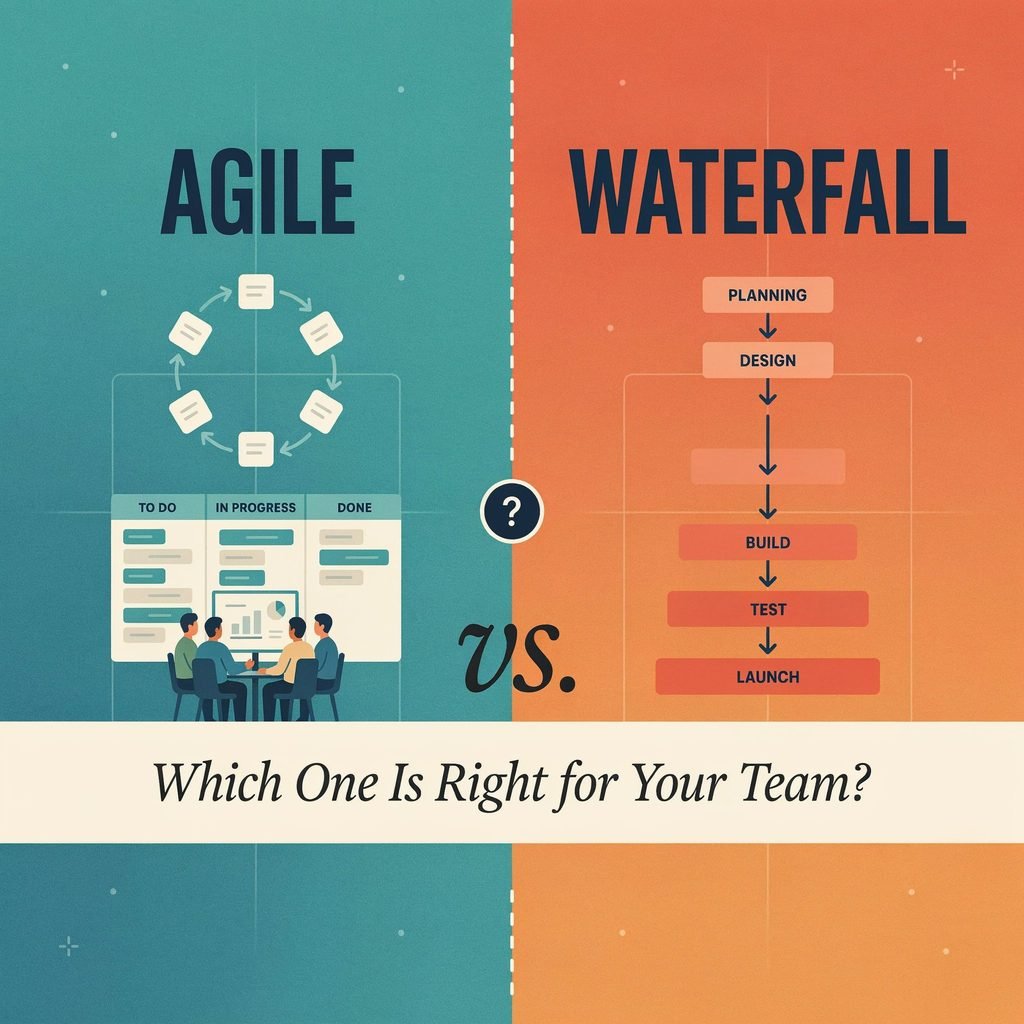
Agile project management is an iterative and incremental framework designed to deliver value faster and adapt to change seamlessly. Instead of betting everything on a massive, final launch, Agile breaks the work down into short, manageable cycles commonly called sprints. During sprint planning, teams commit to delivering small, functional increments of the product by the end of each cycle.
Because requirements can evolve based on real-world testing, Agile thrives on continuous stakeholder feedback. Cross-functional collaboration is central to the process, with designers, developers, and testers working side-by-side rather than in silos. Continuous improvement is also baked into the workflow through regular retrospectives, where the team discusses what went well and what needs adjusting.
There are several popular project management frameworks under the Agile umbrella, including:
- Scrum: Highly structured with defined roles and time-boxed sprints.
- Kanban: Focuses on continuous flow and visualizing work on a board.
- Extreme Programming (XP): Emphasizes technical excellence and frequent releases.
- Lean Agile: Focuses on eliminating waste and optimizing efficiency.
While roles vary by framework, a typical Scrum team includes a Product Owner (who prioritizes the work), a Scrum Master (who removes roadblocks), and the Development Team (who executes the work).
Agile vs Waterfall examples make this clearer. Imagine a software team building a new mobile app. Instead of spending six months building every conceivable feature, they release a basic, functional version after the first sprint. They collect user feedback, realize the navigation is confusing, and spend the next sprint improving the UX while adding a highly requested feature. This is iterative project management in action.
What Is Waterfall Project Management?
The Waterfall project management methodology is the traditional, linear approach to executing work. In this model, each phase of the project lifecycle must be fully completed and formally approved before the next phase can begin. It flows steadily downwards—like a waterfall—through distinct stages.
The typical Waterfall lifecycle includes:
- Requirements gathering: Defining exactly what needs to be built.
- Planning and design: Creating comprehensive blueprints and technical specs.
- Development or execution: Doing the actual work based on the plan.
- Testing: Rigorously checking the final product against the initial requirements.
- Deployment or delivery: Releasing the finished product to the client or market.
- Maintenance and review: Fixing bugs and providing ongoing support.
Waterfall emphasizes detailed upfront planning, fixed scope, and rigorous documentation. Because project scope management is locked in early, it offers highly predictable timelines and budgets. Formal approvals and sign-offs are required at each stage gate, meaning there is very little room for spontaneous changes once the execution phase begins.
Consider a practical example: a construction company building a commercial office tower. They cannot start pouring the foundation before the architectural designs are finalized and permitted. They cannot frame the walls before the foundation cures, and they cannot install the drywall before the electrical and plumbing rough-ins pass inspection. This strict adherence to sequence is the hallmark of linear project management.
Agile vs. Waterfall Project Management: Key Differences
To truly understand the Agile vs Waterfall differences, it helps to look at them side-by-side across several critical operational factors.
| Factor | Agile | Waterfall |
|---|---|---|
| Project structure | Iterative and incremental | Linear and sequential |
| Planning | Ongoing and adaptive | Comprehensive upfront planning |
| Requirements | Evolve over time | Defined and fixed early |
| Flexibility | High | Low |
| Customer involvement | Continuous | Mainly at the beginning and end |
| Delivery | Frequent small releases | One final delivery |
| Documentation | Lighter and evolving | Detailed and formal |
| Risk management | Continuous | Usually planned early |
| Team structure | Cross-functional and collaborative | Often role-specific and phase-based |
| Change management | Expected and manageable | Costly and difficult after approval |
| Best for | Complex, uncertain, evolving projects | Stable, well-defined, regulated projects |
Flexibility and Scope Changes
Agile welcomes change, even late in development, viewing it as a competitive advantage. Waterfall, conversely, relies on strict project scope management. Changing the scope in a Waterfall project usually requires formal change requests, budget adjustments, and timeline extensions.
Planning Style
Waterfall requires exhaustive planning before any execution begins. Agile utilizes rolling-wave planning, where high-level roadmaps are set, but the granular details are planned just in time for the next sprint.
Stakeholder Feedback
In Agile, the customer or product owner is involved daily or weekly, ensuring the final product aligns with user needs. In Waterfall, stakeholders are heavily involved during requirements gathering and final user acceptance testing, but are largely hands-off during development.
Delivery Speed
Agile delivers working increments of value early and often, allowing companies to realize ROI sooner. Waterfall delivers the entire product at the very end of the project lifecycle, which can take months or years.
Documentation and Compliance
Waterfall is heavily documentation-driven, making it ideal for highly regulated industries where audit trails are legally required. Agile values “working software over comprehensive documentation,” keeping paperwork lean and focused only on what is necessary.
Risk and Uncertainty
Agile mitigates risk management in projects by failing fast and adjusting course. If an assumption is wrong, the team finds out within a two-week sprint. In Waterfall, risks are identified during the planning phase, but critical flaws might not be discovered until the testing phase, making them incredibly expensive to fix.
Advantages and Disadvantages of Agile
Advantages of Agile
- Faster feedback loops: You learn what works and what doesn’t almost immediately.
- Better adaptation to change: Market shifts or new competitor features can be incorporated mid-project.
- Early delivery: Working product increments are delivered regularly, providing early value.
- Improved collaboration: Cross-functional teams break down silos and communicate constantly.
- Continuous risk identification: Frequent testing and reviews catch issues before they snowball.
- Higher customer satisfaction: Regular input ensures the final product actually solves the user’s problem.
- Ideal for innovation: Perfect for software, design, marketing, and R&D projects where the end goal is somewhat ambiguous.
Disadvantages of Agile
- Scope creep: Without a fixed scope, projects can expand endlessly if not managed by a strong Product Owner.
- Resource intensive: Requires active, ongoing stakeholder participation, which can drain client time.
- Documentation gaps: The focus on speed can lead to poor technical documentation, causing onboarding issues later.
- Contractual challenges: Can be difficult to use for fixed-bid, fixed-scope agency contracts.
- Requires experienced teams: Self-organization demands high emotional intelligence, communication skills, and technical maturity.
Example: A SaaS company building an AI-powered project management tool uses the Agile methodology. After launching a basic task-tracking feature, user feedback reveals that teams actually want automated meeting summaries. The team pivots, building the AI summary feature in the next sprint, resulting in a massive spike in premium subscriptions.
Advantages and Disadvantages of Waterfall
Advantages of Waterfall
- Clear structure: Defined milestones and phases make progress easy to track.
- Predictability: Easier budget and timeline forecasting due to exhaustive upfront planning.
- Strong documentation: Comprehensive specs and manuals ensure knowledge isn’t lost if team members leave.
- Clear accountability: Formal approval gates make it obvious who signed off on what and when.
- Fixed scope management: Excellent for projects where the deliverables cannot change.
- Regulatory compliance: The heavy documentation trail satisfies auditors in finance, healthcare, and government sectors.
Disadvantages of Waterfall
- Inflexibility: Accommodating late changes is incredibly difficult and expensive.
- Delayed feedback: Customers don’t see the working product until the testing phase, meaning misunderstandings are caught late.
- High risk of late failure: A fundamental design flaw discovered during testing can derail the entire budget.
- Siloed teams: Hand-offs between design, development, and QA can lead to a “throw it over the wall” mentality.
- Delayed ROI: Value is only realized at the very end of the project lifecycle.
Example: An enterprise resource planning (ERP) implementation for a global manufacturing company relies on the Waterfall methodology. The project requires strict requirements mapping, intense data migration planning, rigorous compliance testing, and executive sign-offs before the new financial system can safely go live.
When to Use Agile
Choosing a project management methodology often comes down to the level of uncertainty. You should lean toward Agile when:
- The final product isn’t perfectly defined, and requirements are likely to change.
- The project is highly complex, innovative, or relies on new technology.
- Stakeholders need to see tangible progress frequently to maintain confidence.
- Continuous user feedback can drastically improve the final outcome.
- Your team is collaborative, communicative, and capable of self-organization.
- Speed to market is a critical competitive advantage.
When to use Agile: Project Examples
- Mobile App Development: Where user interface testing and app store feedback dictate feature priorities.
- SaaS Product Development: Continuously rolling out features to retain subscribers.
- Website Redesign: Testing different layouts and conversion funnels iteratively.
- Digital Marketing Campaigns: A/B testing ad copy and adjusting spend based on real-time analytics.
- UX/UI Design Projects: Prototyping, user testing, and refining designs in rapid cycles.
- Startup MVP Development: Building the absolute minimum viable product to test market assumptions before scaling.
When to Use Waterfall
Conversely, when to use Waterfall is dictated by stability, compliance, and physical constraints. Waterfall is the superior choice when:
- Requirements are crystal clear, highly detailed, and strictly fixed.
- The project must follow a rigid, physical, or regulatory sequence.
- Formal audits, compliance checks, or strict contractual obligations govern the work.
- The budget and deadline are entirely fixed, and stakeholders demand predictable, documented plans.
- The client prefers a hands-off approach during the execution phase.
- The team has executed nearly identical projects before, minimizing unknown variables.
When to use Waterfall: Project Examples
- Construction Projects: Building a bridge or skyscraper requires sequential, immovable phases.
- Government or Public-Sector Projects: Taxpayer-funded initiatives require strict adherence to approved budgets and extensive audit trails.
- Medical Device Manufacturing: FDA approvals require exhaustive, locked-in documentation and testing protocols.
- Regulatory Compliance Projects: Implementing new financial reporting standards to meet legal deadlines.
- Large Enterprise System Implementations: Migrating core banking systems where downtime and errors are unacceptable.
- Event Planning: Organizing a massive corporate summit with hard, immovable dates and vendor dependencies.
Agile vs. Waterfall Project Management: Which Is Right for Your Team?
When deciding between frameworks like Scrum vs Waterfall or Kanban vs Waterfall, use this practical decision framework to guide your choice.
| Question | If Yes | If No |
|---|---|---|
| Are requirements likely to change? | Choose Agile | Waterfall may work |
| Do stakeholders want frequent updates? | Choose Agile | Waterfall may work |
| Is the project highly regulated? | Consider Waterfall or hybrid | Agile may work |
| Is speed to market important? | Choose Agile | Waterfall may work |
| Are requirements fixed and documented? | Choose Waterfall | Choose Agile |
| Does the team need to test and adjust frequently? | Choose Agile | Waterfall may work |
| Is the final deliverable clearly known from day one? | Waterfall may work | Choose Agile |
Beyond the checklist, consider your organizational context. Team experience plays a massive role; Agile requires a mature, communicative team, while Waterfall can function with more siloed, junior staff if the plan is robust. Organizational culture matters too—Agile struggles in highly hierarchical, command-and-control environments. Client expectations must also align; pitching an Agile, evolving scope to a client who demands a fixed-price, fixed-date contract is a recipe for disaster. Finally, evaluate the risk level. If failure means a loss of life or massive financial ruin (like aerospace engineering), Waterfall’s rigorous upfront risk mitigation is mandatory.
The Rule of Thumb
- Use Agile when learning, adaptation, and rapid feedback are your primary drivers of value.
- Use Waterfall when predictability, strict control, and heavy documentation are your primary requirements.
- Use a hybrid approach when the project demands rigid governance at the executive level but flexibility at the execution level.
Hybrid Project Management: When Agile and Waterfall Work Together
In the real world, Agile vs. Waterfall project management isn’t always a binary choice. Many successful organizations utilize a hybrid project management approach to get the best of both worlds.
For example, a company might use Waterfall for the initial phases: discovery, budgeting, vendor contracting, compliance planning, and executive stakeholder approvals. Once the project is greenlit and funded, the delivery team switches to Agile for the actual design, development, testing, and iterative delivery.
Another common hybrid model involves using Waterfall milestones for high-level executive reporting and financial tracking, while the delivery team uses Agile sprints and Kanban boards to manage their daily workflow. This allows leadership to maintain their required predictability and budget oversight, while the practitioners retain the flexibility they need to solve complex problems.
The benefits of a hybrid approach are substantial. It provides rigorous structure where it is needed (finance, legal, compliance) and ample flexibility where change is inevitable (product design, software engineering). It bridges the gap between leadership’s need for control and the delivery team’s need for adaptability. This approach is increasingly common in software development, healthcare IT, construction technology, enterprise system integrations, and physical product development.
Common Mistakes When Choosing a Methodology
When choosing a project management methodology, teams often fall into predictable traps. Here are the most common mistakes and how to avoid them:
- Choosing Agile because it is trendy: Don’t use Agile just because it’s popular. If you are building a physical warehouse with fixed blueprints, Agile will only create chaos.
- Choosing Waterfall for control: If leadership demands Waterfall just to “micromanage” a highly uncertain software project, the team will spend more time writing status reports than building the product.
- Treating Agile as “no planning”: Agile requires intense, continuous planning (just in smaller chunks). Failing to plan sprint goals leads to missed deadlines.
- Assuming Waterfall eliminates risk: A 200-page project plan doesn’t prevent risks; it just delays the discovery of them. Active risk management is required in both.
- Ignoring team culture: Forcing a deeply siloed, hierarchical team into self-organizing Scrum teams without training and coaching will result in friction and failure.
- Using Agile ceremonies without delivering value: Holding daily stand-ups and sprint reviews means nothing if the team isn’t actually shipping working, tested increments of the product at the end of every cycle.
Final Verdict
Ultimately, the Agile vs. Waterfall project management debate has no single winner. Agile is the undisputed champion for adaptive, collaborative, and feedback-driven projects where the path to the solution is unknown. Waterfall remains the gold standard for structured, predictable, and documentation-heavy projects where the physical or regulatory sequence cannot be altered.
The best methodology is simply the one that accurately matches your project’s level of uncertainty, stakeholder needs, compliance requirements, and team workflow.
Before starting your next project, take a step back. Map out your requirements, stakeholder expectations, risks, and delivery needs. Don’t force your project into a methodology; instead, choose the methodology—or hybrid approach—that gives your team the perfect balance of structure and flexibility to succeed.
Frequently Asked Questions (FAQ)
Is Agile better than Waterfall?
No, neither is inherently better. Agile is better for projects with high uncertainty and evolving requirements, while Waterfall is better for projects with fixed scopes, strict regulatory compliance, and sequential dependencies.
Can Agile and Waterfall be used together?
Yes. A hybrid project management approach is very common. For example, organizations often use Waterfall for upfront budgeting, planning, and compliance, while using Agile sprints for the actual execution and delivery phases.
Which is easier for beginners: Agile or Waterfall?
Waterfall is often conceptually easier for beginners to grasp because of its clear, linear steps and heavy documentation. However, Agile is often more forgiving in practice, as mistakes are caught in short two-week cycles rather than at the end of a year-long project.
Is Scrum the same as Agile?
No. Agile is a broad philosophy and set of values for project management. Scrum is a specific, highly structured framework within the Agile umbrella that utilizes defined roles (like the Scrum Master) and time-boxed iterations called sprints.
What types of projects use Waterfall?
Waterfall is predominantly used in construction, manufacturing, government contracts, medical device development, and large-scale enterprise IT implementations where requirements are fixed, and strict sequential phases or regulatory audits are required.