Every successful project needs a structured process to turn an idea into reality. Without a clear roadmap, teams struggle with missed deadlines, budget overruns, and confused stakeholders. A well-defined framework provides a repeatable way to define objectives, organize work, manage resources, deliver results, and formally complete the project.
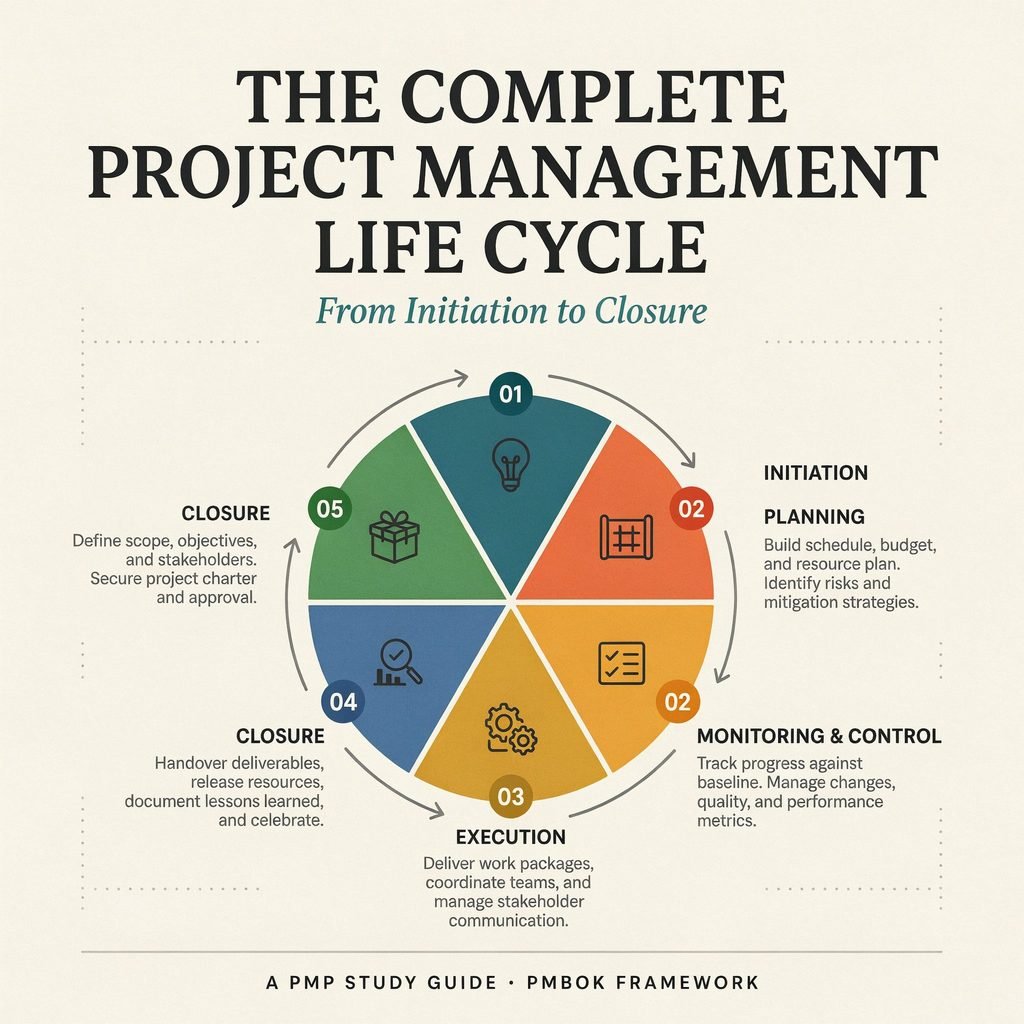
The project management life cycle is a structured series of phases that guides a project from its initial idea through planning, execution, monitoring, delivery, and formal closure. The five common phases are initiation, planning, execution, monitoring and controlling, and closure.
These five major phases form the backbone of the project management life cycle. While they are often presented in a linear sequence, they frequently overlap, especially in agile and hybrid environments. For example, monitoring and controlling takes place continuously throughout execution rather than only at one isolated point. Whether you are launching a new software feature or running a marketing campaign, understanding these project lifecycle phases is essential for project success.
What Is the Project Management Life Cycle?
The project management life cycle is the series of phases a project passes through from its beginning to its completion. It acts as a standardized project management framework that helps teams achieve their goals efficiently. This structured approach helps project teams:
- Define the project’s purpose and project objectives.
- Establish scope and boundaries.
- Assign responsibilities and manage resource allocation.
- Estimate costs and timelines.
- Identify and mitigate risks.
- Monitor performance against baselines.
- Obtain stakeholder approval.
- Capture lessons learned for continuous improvement.
It is important to clarify the difference between several common terms to avoid confusion. A project life cycle represents the chronological stages a project passes through from start to finish. Project management process groups are the logical grouping of activities (Initiating, Planning, Executing, Monitoring/Controlling, Closing) defined by the Project Management Institute (PMI).
A project methodology refers to the specific principles used to manage the work, such as Waterfall or Agile. Project phases are distinct segments of work within the life cycle, often ending with a major milestone. Finally, a project management framework is the overarching structure, tools, and templates that support the methodology. A life cycle describes when things happen, while a methodology determines how the work is organized and delivered. Choosing the right approach ensures your team can adapt to project constraints effectively.
The Five Phases of the Project Management Life Cycle
| Phase | Main purpose | Common activities | Key deliverables |
|---|---|---|---|
| Project initiation | Define the project and secure approval. | Identify business need, assess feasibility, identify stakeholders. | Business case, project charter, stakeholder register. |
| Project planning | Create a detailed roadmap for delivery. | Define scope, build schedule, estimate budget, plan risks. | Project management plan, WBS, schedule, risk register. |
| Project execution | Perform the work and build deliverables. | Coordinate team, manage tasks, communicate progress. | Completed work packages, status reports, interim deliverables. |
| Monitoring and controlling | Track performance and manage changes. | Measure progress, control scope/budget, resolve issues. | Change requests, corrective actions, updated baselines. |
| Project closure | Formalize acceptance and end the project. | Hand over deliverables, close contracts, document lessons. | Final approval, handover documentation, lessons learned. |
Projects do not always move through these project management phases in a perfectly linear sequence. In a website redesign, for instance, planning may be refined during execution as new technical constraints emerge. Risks or scope changes may require the team to revisit earlier decisions, proving that the project management process is often iterative.
Phase One: Project Initiation
Initiation determines whether a project is valuable, feasible, and aligned with organizational goals before significant resources are committed. This phase sets the foundation for strong project governance.
Define the project idea and business need
Every project starts with a problem to solve or an opportunity to seize. You must identify the expected business value, the customers affected, and the consequences of inaction. For example, a business might need a software launch to capture a new market segment before competitors do.
Conduct a feasibility assessment
Before investing heavily, evaluate the project’s viability across several dimensions. Consider technical feasibility, financial return, operational integration, and legal compliance. You must also verify resource availability and timeline feasibility to ensure the goal is realistic.
Create the business case
A business case summarizes why the project should be approved by leadership. It includes the project background, proposed solution, estimated costs, major risks, and alternative options. Crucially, it outlines the expected benefits realization and return on investment.
Develop the project charter
The project charter is a high-level authorization document. It formally names the project manager and outlines the project purpose, high-level scope, major deliverables, and key milestones. It also documents initial assumptions and dependencies and budget estimates.
Identify stakeholders
Stakeholder management begins by identifying anyone who can influence the project or be affected by it. This includes the project sponsor, end users, department managers, suppliers, and regulators. Creating an initial stakeholder register helps you understand each person’s influence, interest, and stakeholder expectations.
Initiation phase deliverables
- Approved business case.
- Project charter.
- Initial stakeholder register.
- Preliminary scope statement.
- High-level milestone list.
- Initial risk assessment.
- Project approval or go/no-go decision.
Is the project clearly valuable, achievable, and authorized?
Phase Two: Project Planning
Planning converts a project idea into a practical roadmap. Weak project planning often leads to scope creep, missed deadlines, budget overruns, and communication breakdowns.
Define project scope
Project scope management involves documenting exactly what the project will and will not include. A clear scope statement defines boundaries, in-scope work, deliverables, and project acceptance criteria. This prevents uncontrolled expansion of the work later on.
Build a work breakdown structure
The work breakdown structure (WBS) is a hierarchical breakdown of project deliverables into manageable work packages. Using a WBS helps teams assign ownership, estimate effort, build a schedule, and identify missing work. It is the foundation of accurate project estimation.
Create the project schedule
Project schedule management requires sequencing tasks, identifying dependencies, and estimating durations. You must determine the critical path, which is the sequence of tasks that dictates the shortest possible project duration. Understand dependencies like finish-to-start (Task B cannot start until Task A finishes) and start-to-start (Task B cannot start until Task A starts).
Estimate and manage the project budget
Project budget management covers labor, materials, software, vendor expenses, and contingency reserves. Always document the assumptions behind your cost estimates. Establish a clear process for handling budget changes as the project evolves.
Plan project resources
Determine required skills, team roles, availability, and external suppliers. When multiple departments are involved, use a responsibility assignment matrix, such as a RACI chart. This clarifies who is Responsible, Accountable, Consulted, and Informed for every task.
Create a risk management plan
Project risk management requires distinguishing between a risk (a potential future event), an issue (a current problem), an assumption, and a dependency.
- Identify risks.
- Analyze probability and impact.
- Prioritize risks in a risk register.
- Assign risk owners.
- Create risk response strategies (Avoid, Mitigate, Transfer, Accept, or Escalate).
- Monitor risks continuously.
Develop a communication plan
A communication plan defines what information will be shared, who needs it, when updates occur, and which channels to use. It ensures smooth team collaboration and keeps stakeholders informed. A good plan prevents silos and aligns distributed teams.
Plan quality and change management
Define quality management standards, testing procedures, and approval requirements. Equally important is the change control process, which dictates how scope changes are requested and analyzed. Changes must be reviewed for impact, approved by a change control board, and properly implemented.
Planning phase deliverables
- Project management plan.
- Scope statement.
- Requirements documentation.
- Work breakdown structure.
- Project schedule.
- Budget baseline.
- Resource plan.
- Risk register.
- Communication plan.
- Quality plan.
- Change management process.
Does the team have a realistic and approved roadmap for delivering the project?
Phase Three: Project Execution
Execution is where the project planning process meets reality. The team performs the planned work and creates the agreed project deliverables.
Launch the project team
Kick off the project with a meeting to review goals, clarify responsibilities, and confirm communication channels. Establish team norms and decision-making procedures early. This aligns everyone on the core project objectives.
Manage project work
Project managers coordinate tasks, resources, and dependencies using task boards, calendars, and collaboration platforms. They ensure the team has what they need to execute the WBS efficiently. Active coordination keeps the work moving forward.
Produce project deliverables
Whether it is a software feature, a marketing campaign, or a construction milestone, deliverables must be evaluated against requirements. Ensure every output meets the project acceptance criteria defined in the planning phase. Quality must be built into the work from day one.
Manage communication and collaboration
Maintain momentum through regular team meetings, progress updates, and decision logs. Keep stakeholders informed with regular reporting. Effective communication prevents bottlenecks and resolves cross-functional conflicts quickly.
Manage suppliers and procurements
If external vendors are involved, monitor contracts, purchase orders, and delivery schedules. Track supplier performance to ensure external dependencies do not derail the project. Active vendor management protects your timeline and budget.
Support team performance
Great project managers remove blockers, resolve conflict, and balance workloads. Recognize contributions to maintain high morale and motivation. This support is especially critical when managing remote or distributed teams.
Execution phase deliverables
- Completed work packages.
- Interim deliverables.
- Progress reports.
- Meeting records.
- Approved changes.
- Updated risk and issue log.
- Quality inspection results.
- Vendor outputs.
Is the team producing the required deliverables according to the approved plan?
Phase Four: Monitoring and Controlling
Project monitoring and controlling occurs simultaneously with execution. Its purpose is to compare actual performance with approved baselines and take corrective action when necessary.
Track project progress
Monitor key performance indicators such as percentage of work completed and milestone achievement. Track resource utilization, defect levels, and overall risk exposure. Data-driven tracking reveals the true health of the project.
Control the project schedule
When delays occur, project managers must respond proactively. Re-sequence tasks, reassign resources, or negotiate deadlines to minimize schedule variance. Protecting the timeline requires constant vigilance and adjustment.
Control costs
Track planned versus actual spending to identify cost variance early. Review financial forecasts regularly to ensure the project does not exceed its approved budget. Catching overruns early allows for timely adjustments.
Manage scope changes
When a stakeholder requests a new feature, follow the change control process:
- Submit the change request.
- Describe the reason.
- Assess the effect on scope, schedule, budget, and risk.
- Obtain approval or rejection.
- Update project documents.
- Communicate the decision.
- Implement the approved change.
Monitor risks and issues
Risks are potential future events; issues are current problems. Regularly update the risk register and issue log to track evolving threats. Escalate blockers immediately if they threaten project success.
Perform quality control
Conduct inspections, peer reviews, and rigorous testing. Track defects and implement corrective actions to ensure the final output meets quality management standards. Quality control guarantees the deliverables are fit for purpose.
Report project status
A useful project status report highlights overall health, completed work, upcoming tasks, and decisions required. Many teams use traffic-light reporting for quick visual updates:
- Green: On track.
- Amber: Requires attention.
- Red: Significant intervention required.
Is the project still aligned with its approved objectives, budget, timeline, and quality standards?
Phase Five: Project Closure
Project closure (or project closeout) formally completes the project. It confirms that all contractual, administrative, and operational requirements are fully met.
Confirm deliverable acceptance
Obtain final approval and formal sign-off from the customer or sponsor. This confirms that all deliverables meet the agreed requirements and quality standards. Without formal acceptance, the project remains technically open.
Complete handover and transition
Project handover involves transferring outputs to operations, support teams, or customers. This includes providing documentation, training, warranties, and defining ongoing maintenance responsibilities. A smooth operational transition ensures the project delivers long-term value.
Close contracts and financial records
Process final invoices, evaluate vendor performance, and release remaining budget. Reconcile all financial records to ensure accurate accounting. Closing procurements formally ends external obligations.
Conduct a project review
Evaluate what went well, what went wrong, and whether the project achieved its intended goals. Assess if the schedule and budget were adequately controlled. This review provides vital insights for organizational learning.
Document lessons learned
Lessons learned should be specific and actionable rather than vague. For example:
- “Weekly risk reviews helped identify supplier delays earlier.”
- “Requirements were not approved before development began.”
- “The communication plan did not account for time-zone differences.”
Archive project records and release resources
Archive project plans, contracts, reports, and approvals in a central repository. Once archived, team members, equipment, and budgets can be released. Releasing resources allows the organization to reallocate them to new initiatives.
Closure phase deliverables
- Final deliverables.
- Customer or sponsor sign-off.
- Handover documentation.
- Final project report.
- Financial closure records.
- Supplier evaluation.
- Lessons learned register.
- Archived project files.
- Resource release confirmation.
Has the project been formally accepted, documented, handed over, and closed?
How Agile and Hybrid Projects Use the Life Cycle
Agile project management still involves initiation, planning, execution, monitoring, and closure. However, these phases repeat across short iterations or Scrum sprints. Instead of delivering everything at the end, Agile teams deliver incremental value continuously.
| Aspect | Traditional (Waterfall methodology) | Agile | Hybrid project management |
|---|---|---|---|
| Planning | Mostly completed before execution | Continuous and iterative | High-level upfront planning with iterative delivery |
| Delivery | Often at the end of the project | Frequent increments | Combination of staged and incremental delivery |
| Scope | Defined early and controlled through formal changes | Flexible and prioritized | Some scope fixed, some scope adaptable |
| Feedback | Provided at formal review points | Frequent stakeholder feedback | Feedback at selected milestones and iterations |
| Best suited for | Stable requirements | Evolving requirements | Complex projects requiring structure and flexibility |
The appropriate life cycle depends on project complexity, requirement stability, regulatory needs, and risk level. It also depends heavily on customer involvement and organizational culture. Selecting the right approach maximizes efficiency and adaptability.
Common Project Management Life Cycle Mistakes
Even experienced managers fall into common traps. Avoid these pitfalls to protect your project and your team.
- Starting without a clear business case: Building something nobody needs wastes valuable company resources. Prevention: Always secure an approved business case and charter before starting any work.
- Approving a vague project scope: This inevitably leads to massive scope creep and frustrated stakeholders. Prevention: Define clear boundaries and project acceptance criteria upfront during the planning phase.
- Failing to identify decision-makers: This causes severe delays when critical approvals are needed. Prevention: Map stakeholders and define the change control process early in the project.
- Creating unrealistic schedules: Ignoring the critical path and team capacity guarantees missed deadlines. Prevention: Base estimates on historical data and involve the team in scheduling.
- Ignoring resource availability: Assuming people are 100% available ignores their operational duties. Prevention: Account for daily tasks, holidays, and context-switching during resource allocation.
- Treating risk management as a one-time activity: Failing to spot new threats leaves the project vulnerable. Prevention: Review the risk register at every status meeting.
- Allowing informal scope changes: Bypassing governance destroys budgets and timelines. Prevention: Enforce a strict change request process for all new requirements.
- Reporting problems too late: Letting small issues become crises damages trust. Prevention: Foster a culture of transparency and use accurate project status reports.
- Failing to define acceptance criteria: This leads to endless revisions and rejected deliverables. Prevention: Agree on exact quality metrics before execution begins.
- Skipping project closure: Leaving contracts open and teams in limbo creates organizational drag. Prevention: Treat project closeout as a mandatory final phase.
- Not documenting lessons learned: Repeating past mistakes wastes future time and money. Prevention: Schedule a mandatory post-mortem meeting before releasing the team.
- Using too many tools without a process: Software cannot fix a broken workflow. Prevention: Define your communication and tracking processes before selecting tools.
Project Life Cycle Checklist
Initiation checklist
- Business problem identified.
- Business case completed.
- Feasibility assessed.
- Project sponsor named.
- Project manager assigned.
- Stakeholders identified.
- Project charter approved.
Planning checklist
- Scope defined.
- Requirements documented.
- WBS completed.
- Schedule developed.
- Budget approved.
- Resources assigned.
- Risks assessed.
- Communication plan created.
- Quality standards defined.
- Change control process established.
Execution checklist
- Kickoff meeting completed.
- Team responsibilities confirmed.
- Work packages assigned.
- Deliverables produced.
- Stakeholders updated.
- Risks and issues tracked.
- Quality reviews performed.
Monitoring and controlling checklist
- Schedule tracked.
- Budget monitored.
- Scope changes assessed.
- Risks reviewed.
- Issues escalated.
- Quality measured.
- Status reports distributed.
- Corrective actions recorded.
Closure checklist
- Deliverables accepted.
- Handover completed.
- Contracts closed.
- Final costs recorded.
- Lessons learned documented.
- Project review completed.
- Records archived.
- Resources released.
Frequently Asked Questions
What are the five stages of the project management life cycle?
The five stages are initiation, planning, execution, monitoring and controlling, and closure. These project management process groups guide a project from initial concept to final completion.
What is the most important phase of project management?
While every phase contributes to project success, strong initiation and planning are often considered the most critical. They reduce uncertainty, align stakeholders, and make execution significantly smoother.
Is monitoring and controlling a separate project phase?
It is commonly presented as one of the five phases in traditional guides. However, in practice, monitoring and controlling activities occur concurrently with execution and span the entire project duration.
What is created during project initiation?
Key outputs include the business case, project charter, initial scope statement, and stakeholder register. Teams also create high-level milestones and an initial risk assessment during this stage.
What is the difference between project execution and project closure?
Execution focuses on performing the work and producing tangible project deliverables. Closure focuses on obtaining final approval, completing project handover, and capturing lessons learned.
Can the project life cycle be used with Agile?
Yes, Agile project management teams use the same broad concepts. However, they repeat planning, execution, review, and adaptation within short, time-boxed iterations or sprints.
What tools help manage the project life cycle?
Common tools include project management software, Gantt charts, Kanban boards, and work breakdown structures. Teams also rely on risk registers, issue logs, dashboards, and document management systems.