Picture this: your team is three weeks into a software build when the client calls. “Can we just add a real-time chat feature?” they ask casually. You say yes. Suddenly, your two developers need another month, your budget balloons by 20 percent, and the original launch date evaporates. Sound familiar?
That single moment—adding one feature without adjusting anything else—is the triple constraint in action.
The triple constraint is the foundational principle in project management stating that every project is bounded by three interdependent factors: scope, time, and cost. Change one, and at least one of the other two must shift. You cannot expand all three simultaneously without consequences.
Whether you’re a seasoned project manager, a PMP exam candidate reviewing core concepts, or a startup founder juggling your first product launch, understanding this principle is non-negotiable. It shapes every decision you make from kickoff to closeout.
In this guide, you’ll learn exactly what the triple constraint is, how scope, time, and cost interact in real projects, why quality sits at the center of the equation, and—most importantly—how to manage trade-offs strategically so your projects stay on track. Let’s dig in.
What Is the Triple Constraint?
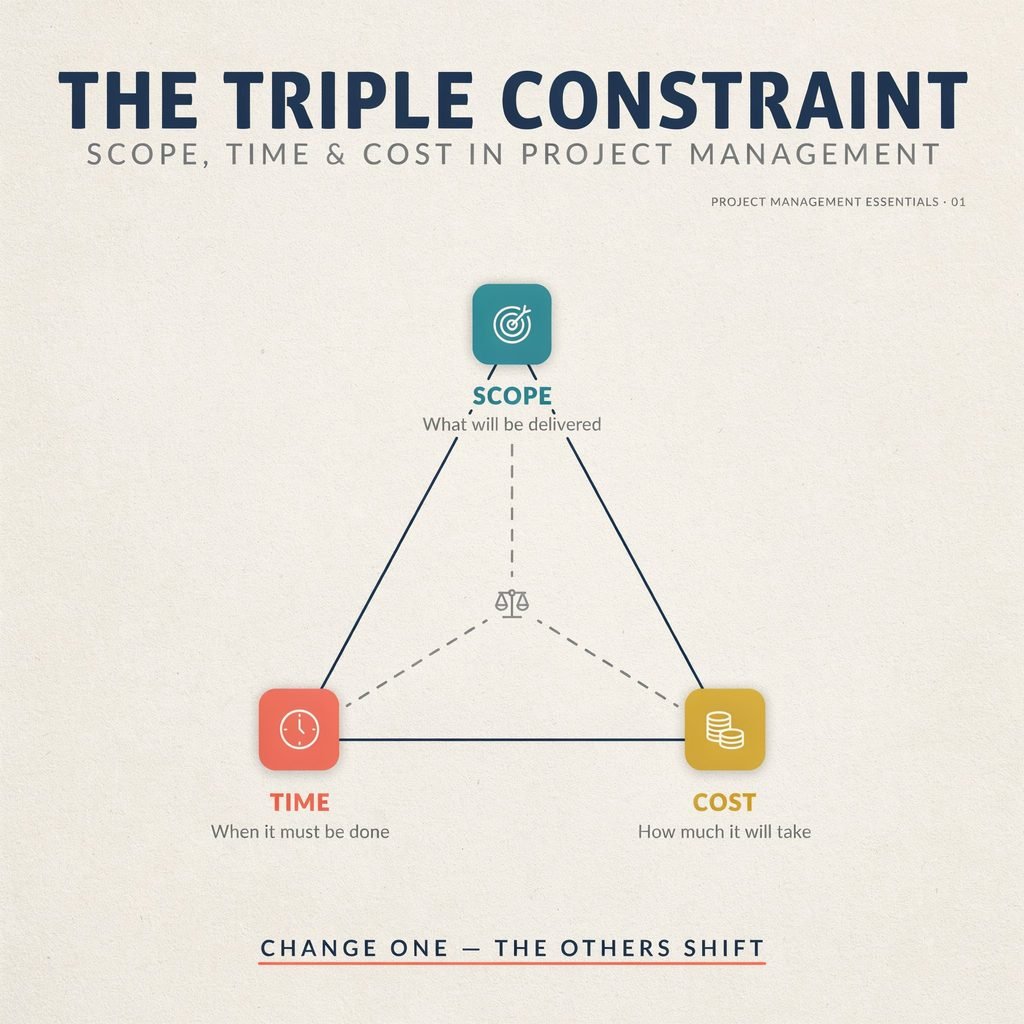
At its core, the triple constraint in project management describes the three primary boundaries within which every project must be delivered: what you’re building (scope), when you need it done (time), and how much you can spend (cost). These three elements form an interdependent system. Strengthen or stretch one side, and the others respond.
The concept is most often visualized as a triangle—hence the name project management triangle. Scope sits at one corner, time at another, and cost at the third. Quality occupies the center. If you pull one corner outward, the triangle distorts, and quality suffers unless you compensate elsewhere.
You’ll also hear this model called the iron triangle project management framework, the project management triangle model, or simply the project constraints triangle. All these terms point to the same idea: project delivery constraints are fixed in relationship to one another, and managing them is the project manager’s central job.
The PMI triple constraint appears prominently in the PMBOK Guide and is a key topic on both the PMP and CAPM exams. If you’re preparing for certification, expect questions that test your ability to identify which constraint is affected when a change request comes in, and what trade-off the project manager should recommend.
But this isn’t just exam theory. Every project you’ve ever run—whether it’s a marketing campaign, a software release, or an office relocation—operates within these three boundaries. Understanding them turns reactive firefighting into proactive decision-making.
Breaking Down the Three Constraints
Scope: What the Project Will Deliver
Project scope definition is the process of clearly stating what the project will produce: the deliverables, features, functions, and requirements that define “done.” It answers the question, What exactly are we building, and what are we explicitly not building?
A well-defined scope is captured in a scope statement and protected by a scope management plan. That plan outlines how requirements will be gathered, how deliverables will be verified, and—critically—how changes will be evaluated and approved.
The scope baseline is the approved version of your scope statement, work breakdown structure (WBS), and WBS dictionary. Once baselined, any modification must go through a formal change control process.
Why does this matter? Because of scope creep—the gradual, often invisible expansion of project requirements without corresponding adjustments to time or budget. A stakeholder says, “It’d be great if the dashboard also showed quarterly trends.” Then another asks for export-to-PDF. Individually, each request seems small. Collectively, they add weeks of work your team never planned for.
Without a clear project scope definition and a disciplined approach to changes, scope creep becomes the number one reason projects blow past their schedule and budget.
Time: Schedule, Deadlines, and Milestones
The time constraint encompasses your project schedule baseline: the approved timeline that includes start and end dates, milestones, task dependencies, and critical path activities. It answers, When must each piece be delivered, and when is the final deadline?
Your schedule management plan defines how the schedule will be created, monitored, and updated. It specifies the scheduling methodology (Gantt charts, critical path method, agile sprints), reporting cadence, and thresholds for flagging delays.
Time is often the most visible constraint because deadlines are public. A product launch tied to a trade show, a regulatory filing date, a client contract milestone—these don’t move easily. When the schedule compresses, you typically face a time–cost trade-off: crash the schedule by adding resources (which raises cost) or fast-track by running tasks in parallel (which raises risk).
Every day a project runs late, labor costs accumulate, opportunity costs grow, and downstream dependencies shift. Time isn’t just a date on a calendar; it’s a financial and strategic variable.
Cost: Budget, Resources, and Financial Limits
The cost constraint covers everything your project consumes financially: labor rates, materials, software licenses, equipment, vendor fees, and contingency reserves. The project cost baseline is the approved, time-phased budget against which you measure performance.
A cost management plan describes how costs will be estimated, budgeted, tracked, and controlled. It sets the rules for variance thresholds, earned value reporting, and escalation procedures when spending trends upward.
Cost isn’t limited to dollars. Resource constraints in projects—limited team availability, specialized skill gaps, shared equipment—translate directly into cost pressure. If your only senior architect is split across three projects, her time becomes expensive and scarce.
When the budget is cut, something else must give. You reduce scope, extend the timeline to use fewer people at once, or accept lower quality. There is no fourth option.
| Constraint | Definition | Key Questions | Typical Risks |
|---|---|---|---|
| Scope | Deliverables, features, and requirements the project will produce | What are we building? What’s excluded? | Scope creep, vague requirements, gold-plating |
| Time | Approved schedule, milestones, and deadlines | When is it due? What’s the critical path? | Unrealistic deadlines, delays, dependency conflicts |
| Cost | Budget covering labor, materials, tools, and reserves | How much can we spend? What’s the contingency? | Underestimation, hidden costs, resource constraints |
How the Triple Constraint Works in Practice
The power of the triple constraint model lies in interdependence. You cannot change one constraint in isolation. Every adjustment ripples through at least one other side of the triangle.
Consider three common scenarios:
- Adding a new feature (scope increases). Your e-commerce client wants a loyalty-points module added two sprints before launch. You can deliver it, but you’ll need two additional developers (cost up) or an extra three-week sprint (time up). If neither is possible, something else in scope must be deferred.
- Moving the launch date earlier (time decreases). Leadership wants the product at a conference six weeks sooner than planned. To compress the schedule, you either hire contractors to parallelize work (cost up) or cut two planned features from the release (scope down).
- Cutting the budget (cost decreases). Finance trims your allocation by 25 percent mid-project. You now have fewer people and tools. The realistic options are reducing deliverables (scope down) or extending the timeline so a smaller team can complete the work (time up).
This dynamic is often summarized by the phrase “fast, good, cheap—pick two.” In fast good and cheap project management discussions, the idea is straightforward: if you want it quickly and at high quality, it won’t be cheap. If you want it cheap and fast, quality will likely suffer. If you want it good and cheap, it will take time.
The project management trade-off triangle isn’t a punishment; it’s a decision-making framework. Your job as the project manager is to surface these trade-offs early, quantify them with data, and let stakeholders choose consciously rather than discover consequences after the fact.
Balancing scope time and budget is not about keeping all three perfectly fixed. It’s about knowing which constraint has the most flexibility on a given project and negotiating from that position.
The Role of Quality in the Triple Constraint
Look at the project management triangle again. Scope, time, and cost form the three sides. Quality sits in the center, affected by every adjustment to those sides.
Quality in project management isn’t a luxury add-on; it’s the degree to which deliverables meet stated requirements and satisfy stakeholder needs. When you compress the schedule, cut the budget, and expand the scope simultaneously, quality is the first casualty. Bugs multiply. Testing gets skipped. Documentation is abandoned. The deliverable technically ships, but it doesn’t perform, and rework costs dwarf the savings.
The scope time cost quality triangle reminds you that protecting quality requires deliberate choices. If a stakeholder demands a tighter deadline and a lower budget while keeping scope intact, you must have the conversation: “Quality will be impacted. Here’s specifically what we’ll have to skip or reduce.”
Project success criteria should be defined at kickoff and revisited throughout. Success isn’t just “on time and on budget.” It’s “on time, on budget, and meeting the quality standards that make the deliverable actually useful.” Frame every trade-off discussion around those criteria so decisions stay grounded in value, not just numbers.
Common Challenges and Pitfalls
Even experienced teams stumble on managing project constraints. Here are the pitfalls that show up most often:
- Uncontrolled scope creep and vague requirements. When the initial scope statement is ambiguous, every stakeholder interprets “included” differently. Small requests pile up without formal review.
- Unrealistic deadlines from stakeholders. A sponsor announces a launch date based on a board commitment, then asks the team to “make it work” without adjusting scope or budget. The schedule is set before the plan exists.
- Underestimated budgets and hidden costs. Initial estimates ignore licensing fees, onboarding time, or contingency. Halfway through, the project is over budget with 40 percent of the work remaining.
- Poor change control and undocumented scope changes. Verbal approvals in hallway conversations replace formal change requests. Three months later, no one can explain why the project looks nothing like the original plan.
- Misaligned stakeholder expectations in projects. The client expects a premium product at a startup budget. Internal leadership expects enterprise-grade delivery on a two-week timeline. Without alignment on which constraint takes priority, every decision becomes a negotiation.
- Ignoring project delivery constraints until they’re urgent. Teams often treat the triangle as a theoretical model rather than a daily management tool. By the time a constraint is breached, options are limited and expensive.
A robust change control process is your best defense against most of these issues. Every proposed change should be documented, assessed for impact on scope, time, and cost, and approved (or rejected) before implementation.
Practical Strategies to Manage the Triple Constraint
Knowing the theory is useful. Applying it is where projects succeed or fail. Here are actionable strategies you can implement on your next project:
- Define and document clear project baselines early. Before execution begins, lock in the approved scope statement, schedule baseline, and cost baseline. These become your reference points for every future conversation. Without them, you’re negotiating in the dark.
- Implement a formal change control process. No scope change—no matter how small—gets implemented without a documented impact assessment. The assessment should state how the change affects time, cost, and quality, and require sign-off from the appropriate authority.
- Prioritize requirements ruthlessly. Use MoSCoW (Must-have, Should-have, Could-have, Won’t-have) or a similar technique. When constraints tighten, you already know what can be deferred without derailing the project.
- Communicate trade-offs with data, not opinions. Instead of saying, “That’ll take longer,” say, “Adding this feature requires 120 additional developer hours, pushing the launch from June 15 to July 8, or adding $18,000 in contractor costs.” Numbers make the scope vs time vs cost conversation concrete.
- Revisit baselines after major changes. If a significant scope change is approved, re-baseline the schedule and budget. Operating against outdated baselines guarantees false variance reports and eroded trust.
- Use the triangle visual in stakeholder meetings. Draw the triangle on a whiteboard. Point to the corner the stakeholder wants to change. Ask, “Which of the other two corners are you willing to adjust?” It’s a simple, powerful way to make the constraint real.
- Align on the project’s priority constraint. At kickoff, agree with sponsors: is this project schedule-driven (the date is sacred), cost-driven (the budget is fixed), or scope-driven (the feature set is non-negotiable)? Knowing which constraint is most flexible guides every subsequent trade-off.
- Build your scope management plan, schedule management plan, and cost management plan as living documents. They shouldn’t collect dust in a shared drive. Reference them in status meetings, use them to evaluate change requests, and update them when approved changes alter the baselines.
These practices turn the triple constraint from a textbook diagram into a daily operating system for managing project constraints effectively.
Real-World Examples of the Triple Constraint
Software project – mid-sprint feature request.
A SaaS team is two weeks into a four-week sprint building a reporting dashboard. The product owner requests an added data-visualization widget. The project manager pulls up the sprint backlog and shows the team’s velocity: 40 story points per sprint. The new widget is estimated at 15 points. Options presented: (a) remove two lower-priority stories from this sprint (scope adjustment), (b) extend the sprint by one week (time adjustment), or (c) bring in a contract developer for the sprint (cost adjustment). The product owner chooses option (a), deferring two stories to the next release. The sprint completes on schedule, the budget holds, and the team avoids burnout. This is a textbook example of project management constraints examples resolved through structured negotiation.
Marketing campaign – deadline and budget pressure.
A retail brand plans a holiday campaign with a November 1 launch and a $120,000 budget. In mid-October, legal flags a compliance issue requiring redesigned ad creative. The redesign adds $15,000 in agency fees. The PM presents the scope vs time vs cost trade-off: absorb the cost and reduce the number of ad variants from six to four (scope down), keep all six variants and push launch to November 8 (time down), or approve a budget increase to $135,000 (cost up). Leadership approves the budget increase because the launch date is tied to a paid-media buy that can’t shift. The PM documents the change, updates the cost baseline, and the campaign launches on time with full creative.
In both cases, the project manager didn’t absorb the change silently. They surfaced the trade-off, quantified it, and let decision-makers choose. That’s the triple constraint working as intended.
Conclusion
The triple constraint isn’t a limitation to resent; it’s a framework that brings honesty to project decisions. Scope, time, and cost are bound together. Adjust one, and the others respond. Quality sits at the center, rising or falling based on how thoughtfully you manage those adjustments.
Great project management isn’t about delivering everything, instantly, for free. It’s about making informed, transparent trade-offs and ensuring every stakeholder understands the cost of their choices. The triple constraint gives you the language and the structure to have those conversations confidently.
Your practical takeaway: on your next project, draw the triangle. Label the corners. Ask your sponsor which constraint is most flexible. Document your baselines. And the next time someone says, “Can we just add one small thing?”—you’ll know exactly which conversation to have next.